This article is from the old blog in 2020:
Preparing for such a trip is not easy. What will I need? What will my travel buddies need? What roads will our cars have to endure? What will the weather be like during the trip? What will break during the trip? When and where? Where can we buy supplies? How much cash do we need? These are all questions running through your mind when you start preparing and setting up countless check lists and consequently shopping lists.
In this post we would like to give you a little insight what Ulrich has been preparing the last couple of months and in the end what we will be taking along on our long trip across West African and into Europe. It is based on previous experiences, reading various blogs, websites but also watching vlogs and Youtube films from fellow overlanders.
Spare Parts
Both cars have had a full service with a thorough check up at our local garage in order not having to worry about that for the first 5,000 km. We should then have arrived in the next capital Dakar where we can have the cars serviced again. However, seeing that the RAV is ageing and we have already had difficulty to finding all necessary spare parts here, we decided to carry a full set of fluids such as engine oil, differential oil, coolant, break fluid and power steering fluid to top up as well as one set of new fresh engine oil filters, engine air filters and fuel filters to change in case it is necessary.
Ulrich has also packed two bulbs of each different major bulb that has been fitted in the car and could brake. What helps in this case is that both are Toyotas and are very similar in its make. That limits the number of spare bulbs to carry.
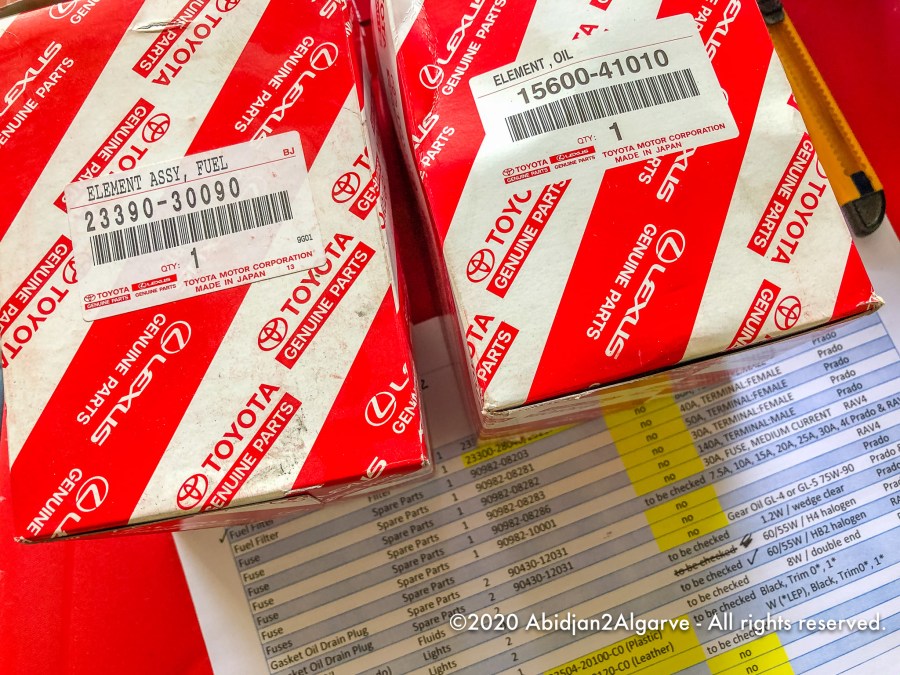
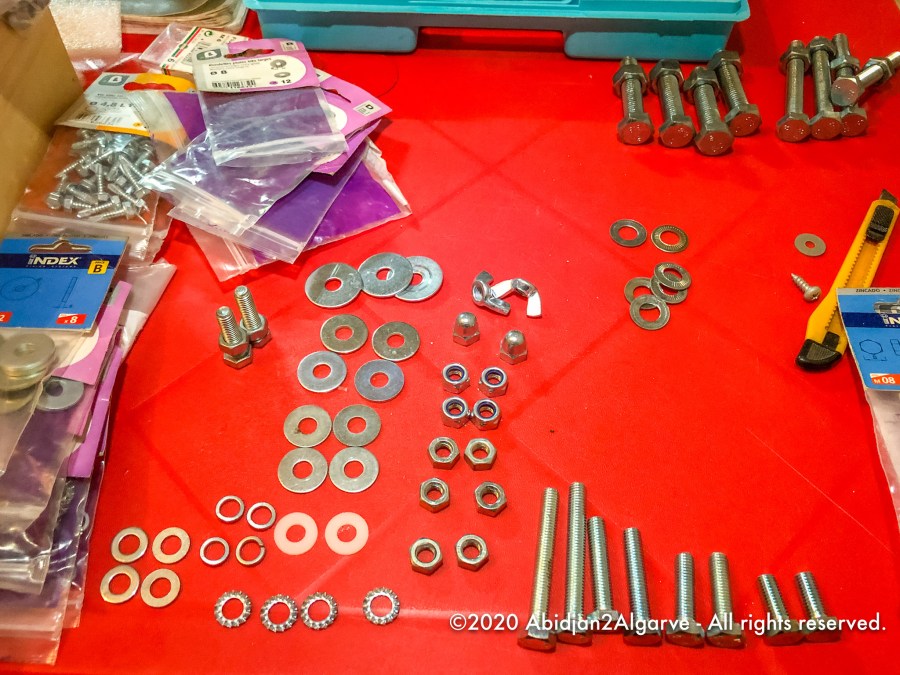
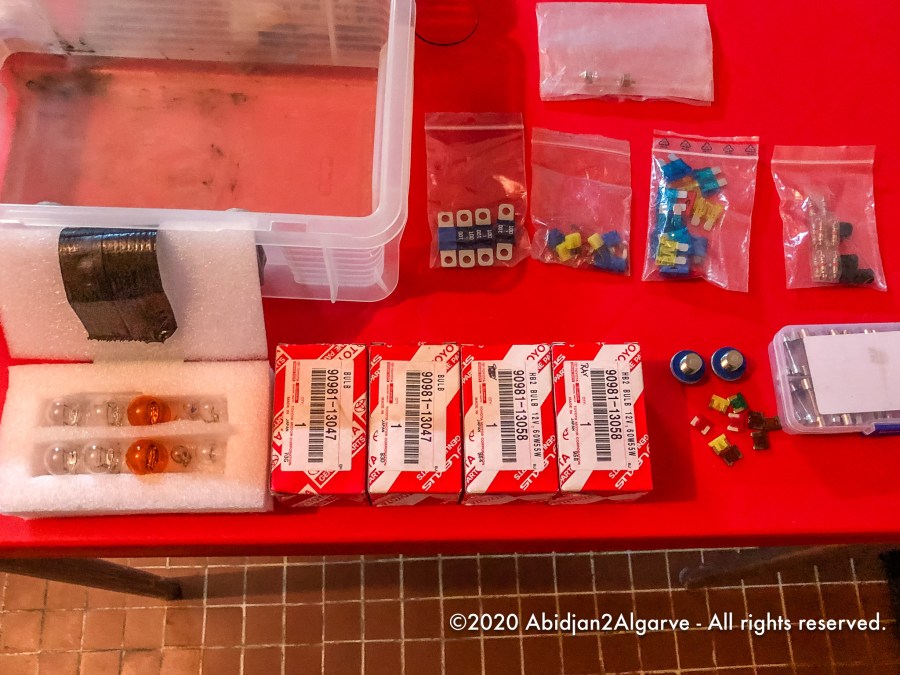
Other spares are being taken along just in case we have trouble with the ones built in. These are a used but still acceptable break pads for front and back for both cars, V-belts and windscreen wipers.
Furthermore, Ulrich’s car carries an assortment of clamps, hoses, bolts, rivets, nuts, cotter pins, washers, tie wraps, glues, lubricants, the good old WD40, break cleaner, tire valves, wires, fuses, electrical cables and connectors, lots of the trusted duct tape, teflon tape and much more small stuff.
Together with an extensive set of tools we hope we are well-prepared for any eventuality to be able to either fully repair or at least get any car going again to drive it to the next larger town for a full repair.
First Aid and Medication
A good first aid kit and how to use it in an emergency saves lives! Especially if you are literally hours if not days away from the next good doctor, hospital or specialist. Good hospitals and doctors are hard to come by in the countryside of West Africa. With the advise of a senior medical doctor and with having had training as an Emergency First Responder, Ulrich has put together a general first aid kit for the expedition to cover the more common medical issues, including mosquito bits and malaria, accidents with cuts or open wounds, (sun) burns, flues, diarrhoea, allergies, infections or muscle induration.
Malaria has to be taken seriously in Africa. After having spoken to several experts in this field who have also all traveled extensively in the region, we decided not to take any malaria quick tests along as they still seem to be too inaccurate and the ones that are accurate enough to be reliable are expensive, require temperature controlled substances and extensive medical knowledge. That is just not doable on such an expedition.
All team members have had Malaria in the past and know the symptoms well. We have good Malaria treatment medication with us and will take it as soon as we feel the symptoms reoccurring. That buys us time to head straight to the nearest town. Every hospital or even larger pharmacies in West African towns and cities are used to Malaria and are capable of doing a reliable test for you.
Additionally every team member has, of course, his or her personal medication needs. They are responsible for these medicine themselves.
Each car has to have the basics so the RAV is also stocked with the necessary first aid and medicine. Care has to be taken what medication is taken as some countries do not allow certain drugs to be taken into the country.
Food and drinks
They say in seafaring “A good cook makes a happy crew.” This is absolutely true for any expedition, be it on the water, in the air or on land. Charlotte, who is responsible for our culinary well-being, has been working hard on the preparations for this trip. She has started to make biltong and droëwors, a South African delicacy (see her article about making those here), as well as on many recipes you can easily and quickly prepare when on a road trip such as this one. We will be attempting to take about two weeks of food supplies with us in each of the vehicles as we have a few uncertainties of restocking possibilities along the way.
We certainly do not want to eat Fufu, Kedjenou, Atjeke or rice with hot sauce all the time, we will be taking along different jars of peanut butter, jams and other easily transportable tins that will nourish us. Spices are easily packed, and fresh fruit and vegetables will be available on the road. Bread will also be available, but we will attempt to make fresh flatbread and bake some bread in the dutch oven, where we can.
Providing enough protein is challenging. Ivory Coast does not have a lot to offer in tinned meat, so we are relying on beans, lentils and other dried protein sources. We will get fresh meat where we can, but to get meat that has been refrigerated after slaughtering will be a challenge. We will rely on fresh fish near the seaside. Tinned fish is available throughout the route, but not a favorite with some of the team members.

We have opted not to take a lot of dried veggies or meal packets, that are available in Canada and the US for hiking. It was extremely expensive and we will be able to make good meals with food that is readily available. The locals survive on these foods so we will follow along. We all are also experienced campers and have been making food over the fire for many years. The South Africans will definitely use every opportunity to braai (BBQ). Frozen meat, covered in lots of newspaper and in a plastic bag, stays frozen in a cooler bag for about two days. We will stock up in the bigger centers where that is available and will take some salami with, where available.
Our cooling capacities are rather limited as we do not have a compressor fridge and have to rely on cooler boxes only. We are sure that we will be able to cook and eat well with our limited capabilities.
Drinking water will mostly be provided from bottled water. Each vehicle carries two jerry cans of 20l or 26l respectively for potable water and Ulrich’s car also has a 20l jerry can for non-potable water (i.e. from a river, well, lake, etc.) to shower, washing or doing the dishes. In case we need to make not-so-trustworthy potable water safe to drink, we will use the trusted One Drop® water purification drops from South Africa. For emergencies we also have a ceramic water filter to produce smaller quantities of potable water.
Other drinks such as fizzy drinks and beer will be sourced locally in the hope that they are well chilled to quench our thirst and wash down the West African dust!
 Abidjan-Marrakech-Abidjan Overland Expedition 2023
You must be logged in to post a comment.