
Not a lot has changed in the Visa world in the past three years since the preparations for the 2020 expedition. For me, as an European citizen, most of the countries along the route are either visa-free, like Morocco, or will easily give me and my travel companions a visa either at the border (Mauritania) or beforehand at the embassy/consulate here in Abidjan, such as Senegal.
But one country is a bit challenging: the Republic of Guinea.
Three years ago, I handed over two sets of filled in visa application forms, my passport, mug shots of me, some photocopies of my passport, yellow fever vaccination, health insurance, hotel reservation, car papers and vehicle insurance together with 80,000 cfa (~120€). Two days later I could pass by the consulate section of the embassy nearby and pick up my passport with a multiple entry visa valid for 90 days and a Laissez-Passer for my vehicle valid for the same number of days. With this visa you could enter the country at any border. Easy.
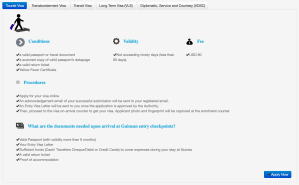
Nowadays, you fill in an application form on the website of the Guinean Ministry of Security and Civil Protection with all your details, upload several documents including your mug shot photo and your passport details page. At the end you have to pay 81.89 USD online with a credit card. Once your application has been approved you receive a one-time Entry Visa with which you can enter the country and then have to head to Conakry where you have to have your biometric data taken either at the airport or at the ministry before they print out a sticker they glue into your passport. This tourist visa is only single entry. Through this new process, not only does this visa get more expensive, but also it costs at least two extra days each way travelling through the country.
I must say, I was impressed by how well this site works and how easy it was to submit everything. As you receive a password, you can stop the application process at any moment, log out and resume again at a later time. Both my travel companions Christoph and Alex, who also need a Guinea visa for our expedition, did the same, submitted the same paperwork. And both of them received their entry visa by email within 24 hours of their submission. However, I am still waiting for mine!
On Monday, I will have to go to the embassy to see what the problem is with my application and why it takes so long to receive.
On a positive note, on Thursday Alex and I passed by the Senegalese consulate here and picked up our passports with multiple-entry visas freshly stamped in. One worry less and one item to be stricken off our long to-do list.
Packing Lists
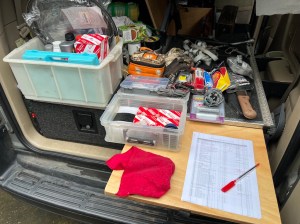
In the past couple of days I have been going through my various packing lists: tools, spare parts, first aid kit, clothing, communication, kitchen/camping, etc. After the cancellation of the 2020 expedition many items went back to their original places in the household, storage or in my workshop. So things had to be gathered again, cleaned and checked. Also now travelling with two people in the car means all the camping gear needs to be times two: 2 camping chairs, 2 plates, 2 knives, 2 forks, 2 spoons, etc.
Every item is evaluated with scrutiny. Do I really need to take it along? Is it really needed or just a nice-to-have item? Can it be replaced with another item that serves more than one purpose. Fortunately, I do not have to watch the weight of my vehicle so much but the space inside the cabin is precious. Lots of decisions are therefore made and items are carefully packed or taken off the lists.
Everything needs to have a permanent spot in the car, either in one of the two drawers at the rear or in one of the storage boxes in the middle section. Priority is given to the items you need on a daily basis and often, such as your camping gear and cooking utensils. Spare parts can be stored deeper in the vehicle but with all the fluids such as oils, they need to stay leak free and secure. One of the most irritating noises in a car needs to be prevented at all cost: rattling. Many items are wrapped or fastened against the notoriously bad roads of West Africa.
Spare Wheel Bag
During my packing I started to wonder what we would do with our garbage and maybe shoes that are filthy or wet. You do not necessarily have that in you car. A short research lead to the solution: a spare wheel bag. Outside and it can stink and leak if necessary. Hmmm, but where to get one, here in Abidjan and before our departure? I still had a bit of thick blue cotton fabric that I was ideal for that. A bit of further research into sizes, designs and functionalities, lead me to think that I could sew this myself.

In my box of fastening straps I easily found three suitable straps long enough to wrap around the spare wheel and secure the bag to it. Maybe not the best colour combination, but after a few kilometres on West African roads and all will be dusty and earth colour. These will certainly do the job!
On Friday evening I sat down trying to figure out in which stages and order I had to sew together my bag so that I could access every seam as easily as possible. The thick blue fabric was quickly measured up and cut. Although the thick fabric and some of the straps meant that my sewing machine had to work hard and I sometimes feared the needle would brake any moment, it managed it very well.

Until late at night I sat at the dining room table and fabricated my bag. The next morning I had to try to fit it to the spare wheel to see if, what I thought up the night before, actually worked. To my joy, the bag is put on in just a few minutes and can also be taken off that quickly. It sits well on the spare wheel.
I think it is a nice and useful addition to the rig and will certainly be used often during the expedition.
 Abidjan-Marrakech-Abidjan Overland Expedition 2023
You must be logged in to post a comment.