
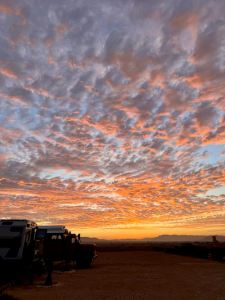
We woke up to a glorious sunrise behind the mountains surrounding Bouizakarne. Quickly got out of tents and snapped some pictures before the colours and the magic fade. It was somewhat chilly. Only about 20°C, when we got up. We are not used to such cool temperatures any more. Rapidly packed up and paid. Our German overlander neighbours waved goodbye as we drove off onto our last real leg of the Northbound journey towards Marrakech.
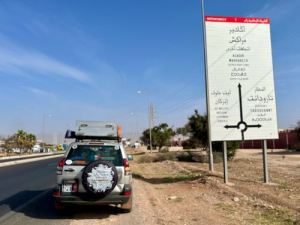
Immediately, we started climbing the mountains of the Anti-Atlas mountain range. Eeyore was struggling, but managed the inclines just a little slower. The road was lined with greenhouses and orchards on both sides. Clearly farming country. We reached the outskirts of Agadir and for the first time on our 5,000km trip we saw a sign mentioning our final destination:”Marrakech”. Of course, I had to stop and snap a picture of this historic moment. The navi wanted to see us on the motorway connecting the two cities. Sure, it would have been shorter and faster, but we wanted to cross the High Atlas mountains via the famous Tizi N’ Test Pass. I had driven this pass a number of times in the past and do remember vividly how beautiful the panoramic views are from the various bends along the serpentine road leading up to the summit at 2,093m, before you are engulfed by the deep valleys and mountains of the High Atlas.
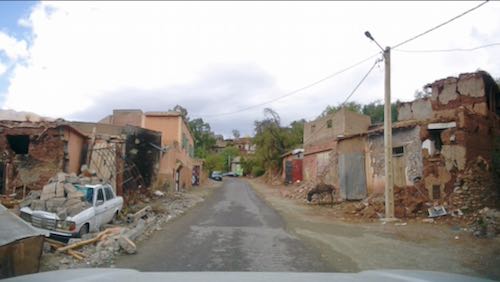
It was right here, where on Friday, 8th September of this year, a little over five weeks ago, the earth shook so violently at 23h11, that many houses collapsed, large boulders rushed down the mountain slopes, parts of slopes slid into the valley and killed around 3,000 people, injuring many thousand and also killed a couple of thousand life stock. The earthquake was felt in the entire region including Marrakech and Agadir. In the days after this devastating earthquake, pictures emerged of completely flattened villages high up in the Atlas mountains. It was hard to imagine what these people, who were lucky enough to survive one of the strongest earthquakes of Moroccan history, are going through having lost family members, loved ones, their entire house and all their possessions! The government rushed in to provide tents, medical facilities and other support. But the winter is coming and already today the temperatures drop into single digits during the night.
Now five weeks on, what does the area look like? Can we pass the mountains on this Tizi N’ Test pass? How much has been cleaned up and how do the villages along the way cope? We wanted to find out and see for ourselves.
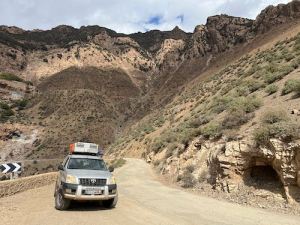
Already at the southern foot of the mountains we saw a strong military and police presence. The trucks were driving back and forth possibly bring aid into the remote villages as they were brand new Renault heavy duty 4×4 trucks. We started climbing the road and started noticing the destruction. The road had been cleared of all debris. Often the edge was missing a guard rail or wall. That had been taken down by the falling rocks.
At several tight turns along the serpentine road there used to be cafes with panoramic terraces. All that is left, are the garden fences and behind that is nothing. The entire cafe, terrace and parking has vanished into the abyss of the valley.
The road was never very wide in the upper section and you always had to pass other vehicles at widened sections. Now, this narrow track was often even smaller due to extra debris on the side. It is evident, that at many places the fallen rocks, some smaller and a few larger ones, were very recent. The mountain slopes are still not stable and probably small aftershocks, rain, sun and wind make them tumble.
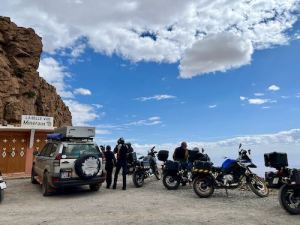
We made it to the last cafe before the summit. It was still there and open for business. Two groups of bikers, one of 14 Royal Enfield Himalayan and one of four BMW 850GS from Norway, had stopped here to have lunch and enjoy the view! We quickly stopped, snapped a few pictures and continued as the place up there was limited.
What was awaiting us in the valleys we drove through, was heartbreaking. Many villages were for 60-80% destroyed. Many houses completely flattened, many more had missing walls or had large cracks you could mistake them for doors or windows. The survivors were all living in self-made or government-provided tents along side the road or on dedicated ground. At these spots, we also saw that medical containers had been set up to provide direct medical aid. Several men walked on crutches on the street. A number of (military) ambulance passed us with sirens on.
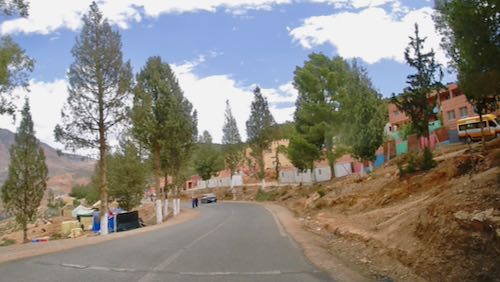
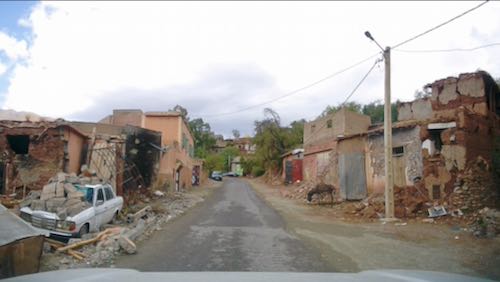
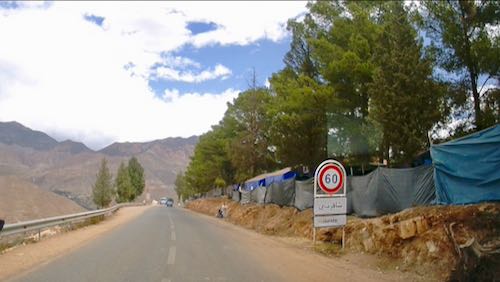

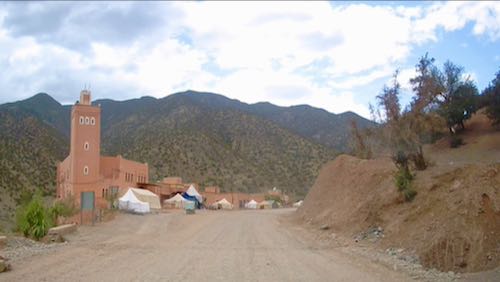
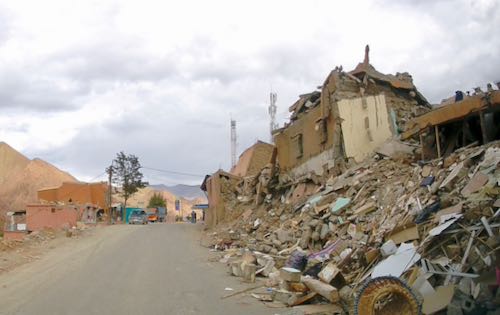
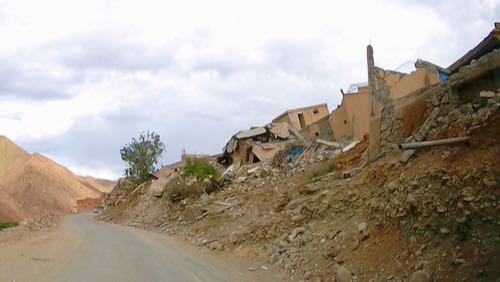
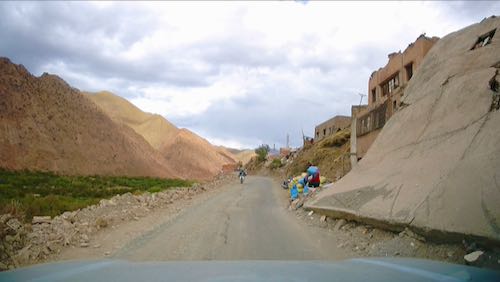

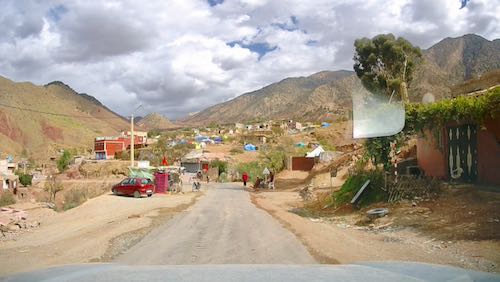
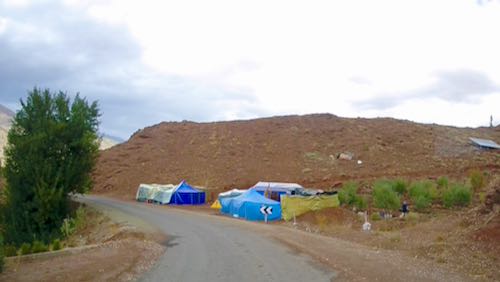

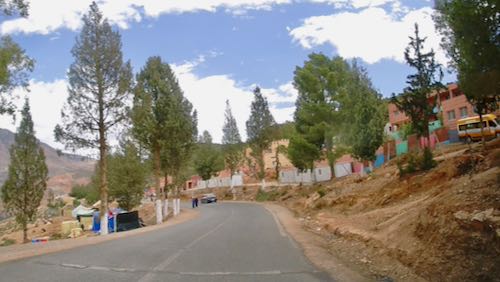
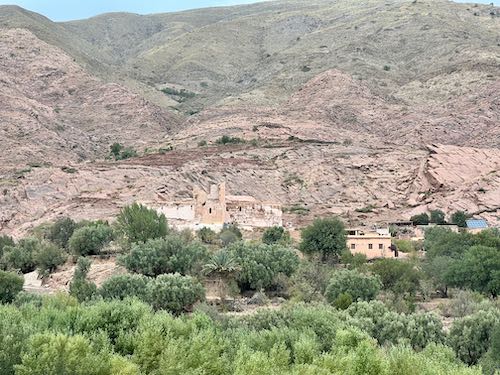
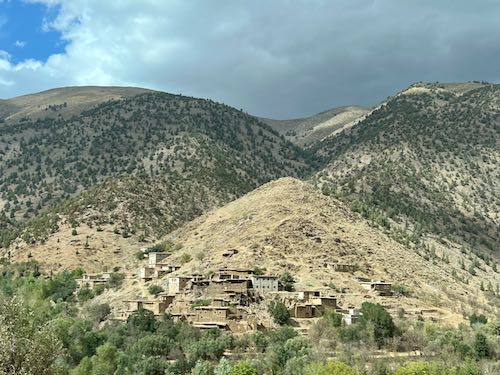
We still saw vehicles buried under rubble, debris not yet cleared away, but people were friendly, started smiling and waving at us. They were genuinely grateful to see foreigners in their villages again. A bit of normality returns. Some cafes and restaurants were open again.
Christoph remarked that the area looks like a war zone and the comparison was certainly not very far off. As we made our way through the valley, we were astonished to see one village with very little damage and a few bends further, the next village was almost completely destroyed.
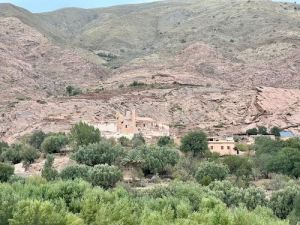
From the international media I had already read the sad news, that one of my favourite spots along this route had been totally destroyed by the earthquake: the 12th century mosque of Tinmel. I have visited it several times in the past and was fascinated by its architecture and its endurance having survived almost 1,000 years. A few seconds in September 2023 levelled this ancient jewel, that is now lost for ever! Heartbreaking!
Already before the quake the government had started widening and modernising the road. Large sections were cut out of the hills. As it had not been surfaced yet, it was super dusty with all the traffic and military vehicles driving through.
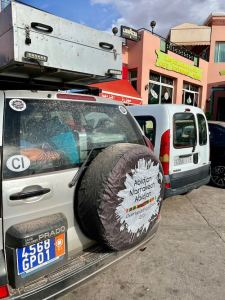
We were very happy when we had finally made it back on tarmac near Asini and then to the regional capital Tahannaout, where we stopped at one of our favourite places for an excellent early dinner.
Christoph mentioned that he felt a bit drained, relieved and emotional as this part of the expedition comes to a close for him. Tomorrow evening he will be sitting in a plane back to Abidjan.
Today’s sleeping place for us, is the kindergarten in a little village, my parents opened in 2008 and it has been educating young children based on Montessori. We were warmly greeted by the caretaker Majoub and the Imam of the village who happened to walk past.
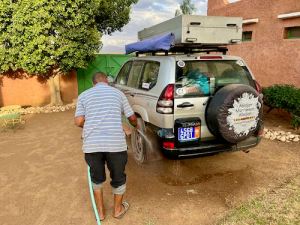
Eeyore was parked and Christoph received a short guided tour. The vehicle was so dusty and dirty from the past 5,500km that we swiftly gave him a wash. Now he sparkles again and is ready for the big finale tomorrow morning on the main square of Marrakech: Jemma El Fna. Our imaginary finish line where some friends will await us!
 Abidjan-Marrakech-Abidjan Overland Expedition 2023
You must be logged in to post a comment.