
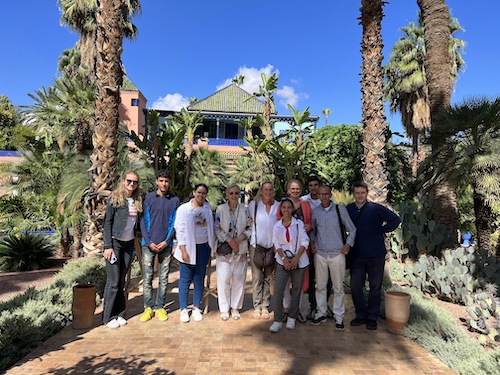

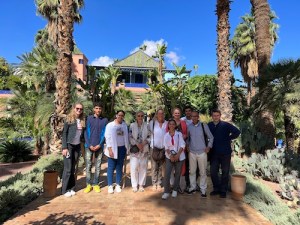
In two grand taxis we set out to visit one of the touristic highlights of Marrakech: the Jardin Majorelle. The garden is a one-hectare botanical garden and artist’s landscape garden in the neighbourhood of our hotel. It was created by the French Orientalist artist Jacques Majorelle over almost forty years, starting in 1923, and features a Cubist villa designed by the French architect, Paul Sinoir in the 1930s. The property was the residence of the artist and his wife from 1923 until their divorce in the 1950s. In the 1980s, the property was purchased by the fashion designers, Yves Saint-Laurent and Pierre Bergé who worked to restore it. Today, the garden and villa complex is open to the public. The villa houses the Berber Museum and in 2017 the Yves Saint-Laurent Museum opened nearby.
We, some of the Kindergarten youth, and Heike, Julia, Angi, Brahim, my mother and me, arrived with the taxis and were guided by staff into the correct line for the 12 o’clock entry. It was super busy. You clearly noticed, that the autumn holidays in Europe are in full swing and Marrakech is very popular with families with children of all ages and other tourists. On the pavement, we stood in line with more than 100 people waiting for the gate to open. I felt like being part of a flock of sheep, ushered into the slaughterhouse. Finally, our time had come, and slowly by surely we moved forward inch by inch. We made it to the entrance and the guard scanned the first digital ticket on my phone, that we had bought online the day before. We needed two online tickets, as we had two different nationalities to look after, Moroccans/foreign residents and visitors, as they call us foreign tourists. Locals and residents pay 60% less than the visitors. The second QR code was quickly scanned and we got counted to be let in.
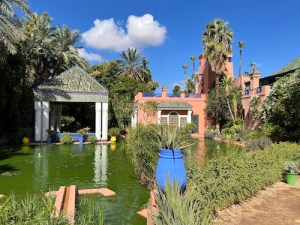
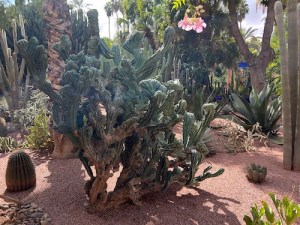
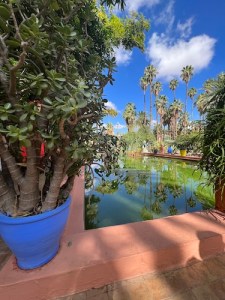
Through the old gate, we entered the magical botanical garden. Again, we had no choice in how to explore the gardens. Guards in Majorelle blue uniforms directed us on the garden tour route. We enjoyed the various plants, bamboo, cacti and palm trees. Many plant pots and buildings were painted in the typical bright Majorelle colours, yellow, red, green and the special Majorelle blue. Many pictures were taken of the garden and of each other. We also walked through the romantic former private gardens of Yves Saint-Laurent (YSL). Next stop was the Berber museum in the former villa of the founder Jacques Majorelle. With our all inclusive tickets, after waiting in a long queue for some time, we gained access and enjoyed learning all about the Berber culture and its beautiful jewellery. Our youth was in awe, as they had not yet seen some of these items being part of their own heritage.
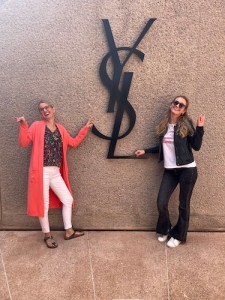
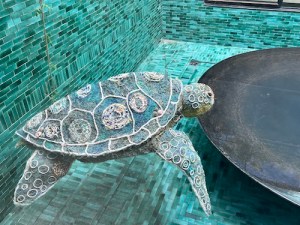
The last station was the Yves Saint-Laurent Museum. Tickets scanned and we arrived in an impressive oval courtyard with a wall and on it the large YSL logo. A nice photo opportunity. Pictures snapped and we went inside where we got greeted by a stunningly beautiful blue and turquoise sea turtle made from some kind of coloured hemp and thread, hanging above a big water overflowing dish in a turquoise tiled inner courtyard. If it had been available for sale, I am sure many of us had bought one. Stunning!
The exhibition of abstract snake paintings and sculptures from Aborigines in Australia was interesting, although we commented, that some of the paintings looked very much like those made by our kindergarten children.
We further saw a few of the dresses, as a sketch and as the real dress, Yves Saint-Laurent had designed in his lifetime. Unfortunately, you could not really see all the details of the dresses, as they had been made from black fabric, placed in front of a black wall with limited lighting. Quite disappointing.
Time for some lunch! It was difficult to get a taxi around this time of the day, that would take us just a few streets further to one of the more authentic areas for a local lunch. Eventually, Brahim found a driver in his vast phone book that would take us. While waiting for him, we were witnesses of a typical Moroccan street scene. In front of the museum you are allowed to only drop off people with cars and, therefore, “no-parking” signs are placed everywhere. Two taxis had dared to stand in front of the museum a bit too long for the liking of a police officer on a moped. He parked his moped perpendicular to the road to write them a ticket. Just as he had finished with the first one and walked over to the next, the first taxi driver “overlooked” the police moped while driving off and scratched along the back mudguard of the moped causing it to tilt dangerously. The museum guard save it from falling over. The police officer returned angrily to start a vigorous discussion with the first taxi driver. In the meantime, the second taxi driver decided it was a good opportunity to escape the ticket and drive off. We heartedly all giggled at this drama unfolding in front of us.
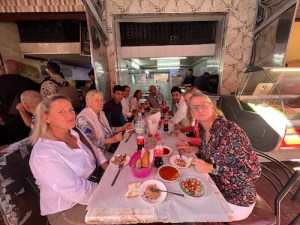
The lunch was at one of the eateries usually used by locals for a quick lunch. We ordered a big plate of various sausages, lamb chops, beef skewer and chicken pieces, accompanied by a Moroccan salad, some fries and bread with olives and harissa, a spicy hot sauce known to be eaten with any Moroccan food. Theirs was excellent. We had too much to eat, but didn’t mind. For our German first-time guests an incredible experience.
 Abidjan-Marrakech-Abidjan Overland Expedition 2023
You must be logged in to post a comment.