
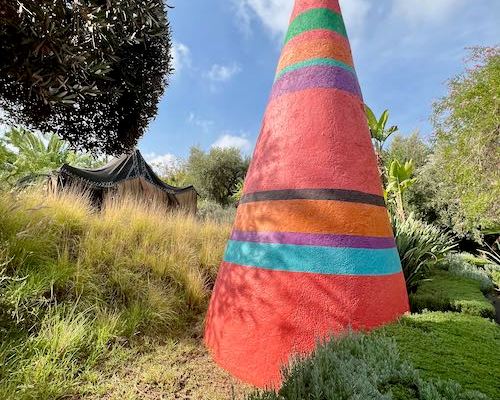
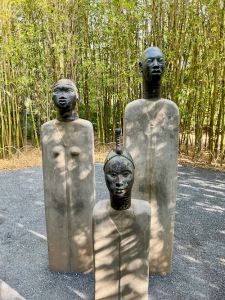
Our Saturday excursion programme took us south, towards the Atlas Mountains near a village called Ourika. For a long time we had wanted to visit the magical garden, the well-known Austrian artist André Heller had created with art works of Keith Haring, Igor Mitoraj, Edgar Tezak, Pablo Picasso, Hans Werner Geerdts, and many other locally and internationally renowned artists.
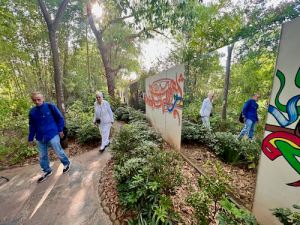
The diverse array of sculptures, paintings, and installations at Anima Garden creates a unique and immersive artistic experience.
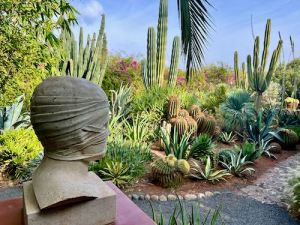
The visit is often described as a trip into another world, where art and nature are lovingly intertwined. The three hectares of red soil have been transformed from 2010 within a couple of years into a lush garden with hundreds of plants and home of many birds and insects. It invites you to stroll around, observe and reflect.
Cramped into our grand taxi, we drove out there in the morning. Although I had booked and paid for tickets online for us all, we had to exchange those online tickets into physical ones at the cashier for some non-comprehensive reason because they were not checked again later. Moroccan logic.
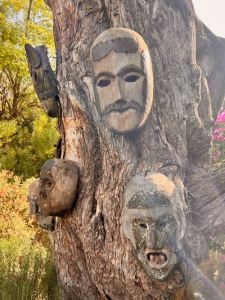
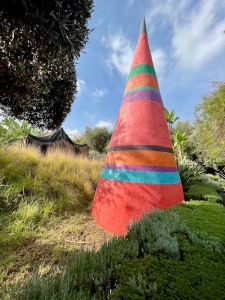
Then, we were ready to enter into this magnificent garden. The paths are gravel and narrow. The garden lush and at every corner you can discover a new piece of art, from a few painted stripes on a palm tree, a metal mobile hanging from a branch, some sculptures on poles to 5m high concrete cones painted in various colours or a 2.5m high tiled head spraying water every couple of seconds. It was a discovery tour. At various places, there are beautifully decorated benches and seats that invite you to sit down, relax and to let your soul dangle a bit.
We strolled, I believe, every inch of walk way in the garden, enjoyed the African autumn sun and the many art pieces!
Almost next across the street is another highlight in the region. A saffron farm, run by a Swiss lady, offering a tour also around her botanical garden and a bare foot experience, we didn’t want to miss. This place had been recommended to us by our friend Peter, who not only thoroughly enjoyed the garden but also the food there. Christine, the proprietor, welcomed us warmly and explained everything. We got the chance to see the first crocus flowers in the field this season.
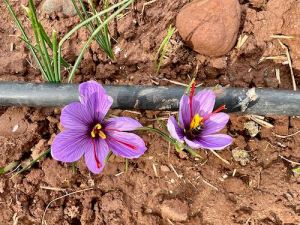
On 2 hectares, they have planted around 600,000 saffron bulbs.
The flowering period, when harvest begins, is in November, and lasts for three to four weeks. This is the same everywhere in the world, and differs from the crocus flowers in Europe, which grow in the spring.
The harvest, one flower at a time, is done early in the morning. Then about 50 Berber ladies, work as a team, gently remove the saffron filaments. This labour-intensive task must be completed by the end of each day, since new flowers appear during the night. Later, the saffron filaments are dried in a dehydrator. It takes about 3.5h to harvest 1 gram of saffron. In order to obtain one kilogram of saffron, between 150,000 and 200,000 flowers are needed.
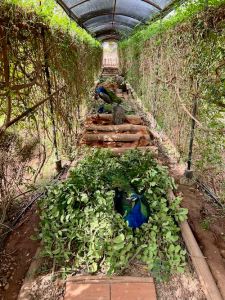
We strolled through the botanical garden with many herbs and fruit trees. One of the highlights is the barefoot-trail, a walkway comprised of about 40 different attached compartments filled with different materials you have to walk across barefooted. The content include thyme, palm leaves, sand, wood, gravel, pine cones, rocks and other leaves. I took off my shoes and socks and to give it a try. Two parts were a green tunnel, where I had to chase away the many peacocks and chicken, before I could pass. My mum wanted to feel this experience too and asked me to support her along the way which I did with pleasure. She did very well. The trail finishes in the footbath-experience. You hold your feet in various bowls filled with clean cold water, salt, herbal waters or water with flowers. At the end you finish off with a bowl of nice warm water, dry off your feet and put on your socks and shoes again. Not only do your feet smell good afterwards, they are also relaxed and well supplied with blood. A very nice and relaxing new experience.
Christine had prepared a table for us to sit and taste their farm-made olives, Berber bread and herbal tea with saffron. Very tasty indeed.
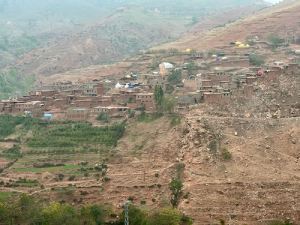
For the return route we had chosen a slightly longer but much more dramatic and scenic route through the Atlas Mountains. Although our taxi driver drove quite fast and we were thrown from side to side in these tight curves, we thoroughly enjoyed the scenery and seeing the various Berber villages hugging the steep slopes of the Atlas Mountains. The further we came to Tahannaout, the more tents in the villages we saw, that indicated the increased amount of earthquake damage.
As we hadn’t had lunch yet, we stopped at one of our favourite food places in the region in Tahannaout for Linner. We had a nice local goat tajine, brochette and pizza.
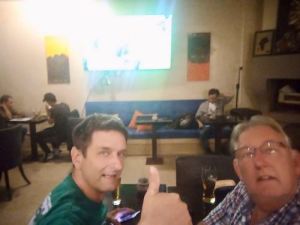
At 8pm it was high time to support the Bokkies, the Springboks, the South African national Rugby team in their final match of the Rugby world cup in France. Trevor and I went over to our favourite watering hole “Cafe du Livre” next door. Khalid, the barman, had reserved us the best tables with a direct view on the big screen. With a bit of patience, the channel was found that broadcasted the match and two beer placed in front of us. The match could start.

Shortly after half time, a South African lady came to us and told us that although she supported the game and team, she was very sorry but had to “confiscate” the screen for Karaoke. We tried to negotiate, but she wouldn’t have any of that. Disappointed, we gulped down out beers and were ready to pay and leave. Khalid was astonished to see us leaving early and asked for the cause. We told him. No, no, no, the Rugby has priority! By that time, we had found a few other supporters in the room. The remote was snatched away and the channel changed back to the final. Two fresh beer on the table, and luckily we hadn’t missed much. The All Blacks, New Zealand’s mighty Rugby team, played hard and scored. They came very close. The last minutes were nail biting. Would this one point ahead be enough? We counted down the seconds. Another scrum close to the line.
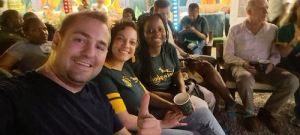
At the score of 12-11, they pushed, but then the referee whistled and the Springboks had beaten New Zealand winning the Webb Ellis Cup for a record 4th time. Cheers on our side, big cheers at many locations throughout the world where South Africans had watched the match. We exchanged messages with friends and family who had also watched the match and were celebrating. Alex had, of course, watch the final with his wife Lele and friends in Abidjan. He sent us a video of an ecstatic crowd.
 Abidjan-Marrakech-Abidjan Overland Expedition 2023
You must be logged in to post a comment.