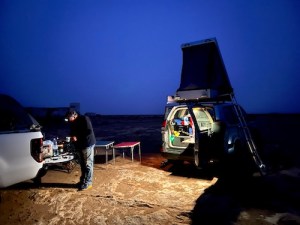
The night was quiet, despite that we were not alone and had about twenty other camper on the parking. Most of them French, some Belgian and Swiss. And not to forget our Dutch friend with his bicycle. We were, of course, the exotic ones.During the night, the military guards kept a close watch on what was happening on the informal camping and along the entire coast, as it is their duty. They are actually stationed every couple of kilometres along the entire coastline for various duties, to protect the sea waters off the coast from illegal fishing, to protect the territory from illegal landing of drugs or other contraband and, above all, to prevent the illegal emigration of people to the Canary Islands, which are EU territory and are very much favourited by subsaharan asylum seekers. At the camping they were, therefore, also keeping a very close watch on the fishing boats moored in the river mouth and could have easily been hijacked for a crossing. During the night the guards sometimes shown their very strong and bright spotlights across the land several times. That woke me up again and again.

We got up on time, seven a.m., when it was still dark. The sky was grey and the stars had disappeared in the fog that had moved in during the night. The humidity was at almost 100% and the dew was building up again on our tents and cars.We had our coffee and breakfast and broke down our tents. Stijn, our Dutch cyclist, came over for a last chat, some bottled water and exchange of phone numbers.We said our goodbyes, and were the first to leave into the misty morning.
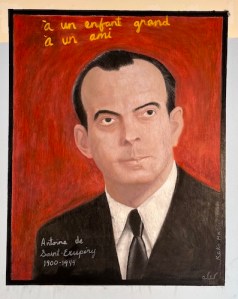
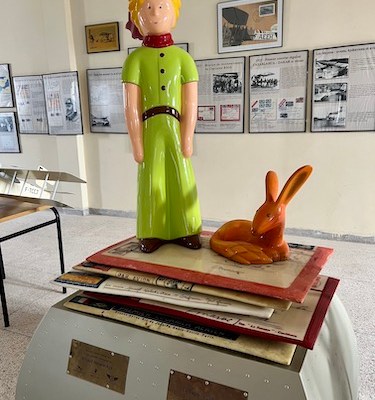
Our first stop of the day was in Tarfaya, a famous town on the Moroccan coast, due to its importance in the early 20th century in French aviation, postal service and the temporary home of Antoine de Saint-Exupéry. In case you don’t know his name, he was a French writer, poet, journalist and pioneering aviator. He received several prestigious literary awards for his novella ‘The Little Prince’ (Le Petit Prince) and for his lyrical aviation writings, including ‘Wind, Sand and Stars’ and ‘Night Flight’.You cannot pass by Tarfaya and not visit the little museum dedicated to this great man. He became one of the pioneers of international postal flight, in the days when aircraft had few instruments. Later he complained that those, who flew the more advanced aircraft, had become more like accountants than pilots. He worked for Aéropostale between Toulouse and Dakar, and then also became the airline stopover manager for the Cape Juby (nowadays Tarfaya) airfield in the at the time Spanish zone of South Morocco, in the Sahara desert. His duties included negotiating the safe release of downed fliers taken hostage by Saharan tribes, a perilous task that earned him his first Légion d’honneur from the French Government.‘
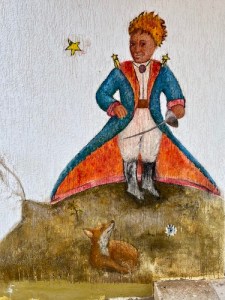
The Little Prince’ was first published in English and French in the United States in April 1943 and was published posthumously in France following liberation. The story follows a young prince who visits various planets, including Earth, and addresses themes of loneliness, friendship, love, and loss. Despite its style as a children’s book, ‘The Little Prince’ makes observations about life, adults, and human nature.‘The Little Prince’ became Saint-Exupéry’s most successful work, selling an estimated 140 million copies worldwide, which makes it one of the best-selling in history. The book has been translated into over 505 different languages and dialects worldwide, being the second most translated work ever published, trailing only the Bible. ‘The Little Prince’ has been adapted to numerous art forms and media, including audio recordings, radio plays, live stage, film, television, ballet, and opera.
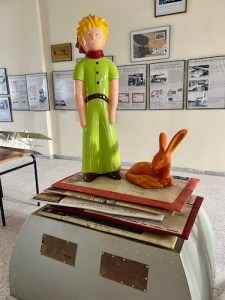
Enough of the introduction of who this man was and what he wrote, this little museum is run by a dedicated group of local volunteers. We found the door locked, but no wonder on a Sunday morning. We rang the phone number pinned on the entrance door and about fifteen minutes later a friendly gentleman came and opened all doors and windows to let light into the small hall, where the exhibition was. I was amazed by the quality of the displays and the aeroplane models exhibited. Honestly, I did not expect that high quality in a little museum in a small Moroccan town. It was totally worth the 30dhs per person entrance fee.
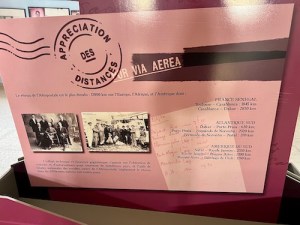
You learn not only about the man himself and his life becoming an aviation pioneer and writer, but you are also taught the history of French aviation, especially delivering letters from France via Spain to Northern Africa and later beyond to Dakar and South America. Mainly thanks to Antoine Saint-Exupéry and his colleagues.With a boost of knowledge, we left the sleepy town, filled up our tanks with cheaper diesel, than in Northern Morocco and hit the road south.
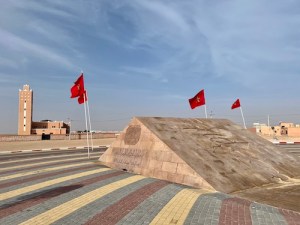
In the middle of nowhere lies the village of Tah. This place is the former border post between the former colony of ’Spanish Sahara’, nowadays the southern province of Morocco and the northern Kingdom of Morocco. In 1975, the Green March marched pass this place. In memory of this March and occasion, the government has erected a large memorial in honour of the late Moroccan Kings Hassan I. and Hassan II.We stopped at the monument that lies in the middle of a roundabout. Quickly, I noticed that something was different. A quick search in my pictures from a month ago, I saw the difference immediately. Most likely for the celebration of the 48th anniversary of the Green March on November 6th, they had transformed and beautified the place by placing a large sign in the middle, removed the old traces of the road leading through the middle and repaved the entire square with new stones in a geometrical pattern. The Moroccan flags were still flying in the wind. After having taken pictures and looked at the two monuments, we carried on.

At the entrance to the capital of the Sakia El Hamra province, Laayoune, we were stopped by the police. Often they wave you through as a foreigner, but this time on a not so busy Sunday morning, they were interested in who we were, where we came from and where we were going to. Brahim explained everything politely in Arabic and also added that the white vehicle behind us belonged to us. That acknowledging, the police officer wished us a nice day, that we returned and he walked to Trevor’s car. As we later heard, he greeted Charlotte as ‘Madam Angela Merkel’ and that it was an honour. They all chuckled and we were sent on our way again through the sleepy but beautiful administration town of Laayoune. Only a few military personnel were out and about. We left the city centre and Trevor was reminded by another friendly police officer to please respect the Moroccan speed limit.
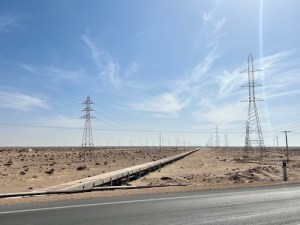
We arrived in the adjacent town of El Marsa. On the bridge across the longest conveyor belt in the world we stopped for a brief moment to snap pictures, as we would have blocked the non-existing traffic. Quote from Day #13: “The 100km long conveyor belt connects the Bou Craa phosphorus mine with the factory in El Marsa and the port, from where it is shipped around the world. Phosphorus is a major component in many products from fertilisers, food additives and matches to water softeners. The factory is one of the largest employers in the region.”
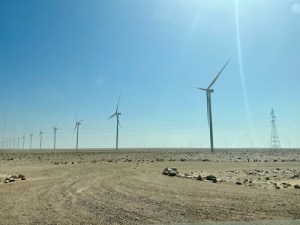
On a now single lane road, we headed South towards the sun and further along the coast, the borderline between the Atlantic Ocean and the Sahara desert. Long and boring kilometres followed. The landscape didn’t change much and the road was taking us past a large wind turbine park with many high voltage masts to carry the green energy into other parts of the country or even abroad. At the city entrance of Boujdour we were controlled again by the police. This time, they wanted to register us, as they did four weeks ago, when I passed the same checkpoint with Christoph onboard. Normal security procedure.

Once done, we headed into town. Trevor had expressed the wish to eat grilled lamb chops again before leaving Morocco. We asked around and nobody was available to help. Most cafes were showing the inaugural African Football League match between Mamelodi Sundowns from Pretoria, South Africa and Wydad AC from Casablanca. Unfortunately, as we learned later, Casablanca lost 2:0. One friendly person directed us to the other side of town. When we reached that side, I immediately recognised the street and one of the restaurants. Exactly one month ago, I had eaten there very well with Christoph. We sent him a teaser by WhatsApp. Brahim ordered one kilogram of grilled lamb chops and for everyone a Moroccan salad. We had a feast. It was very delicious, so good the we licked our fingers afterwards and that all for 200 dhs including drinks.
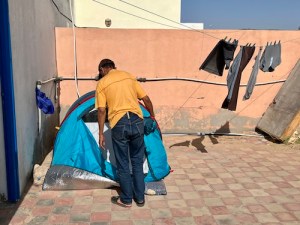
The only camping in town is near the corniche. It looks neglected and has certainly seen better days. But it will do for a night and the toilets and showers are clean and functional. We have free choice and opt for a spot out of the strong northerly chilly wind. Brahim chose the far back wall of the car wash port as his place to set up camp. Eeyore will stand in front of the car wash port as it is more level and Charlotte & Trevor have opted for a very simple twin bed room, as they feared that their huge tent would be blown away in the strong winds.
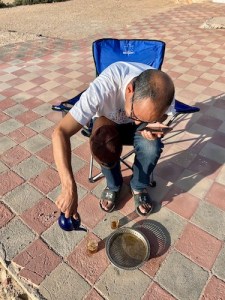
The owner brought Brahim and me some ‘Moroccan whiskey’, i.e. mint tea, that was so strong, it could wake up the dead. In the afternoon sun we sat in the car wash bay, out if the wind and sipped our tea. What a joy!
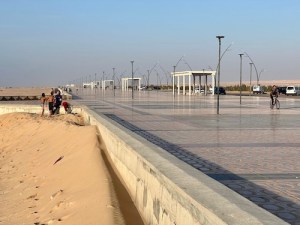
Afterwards we walked over to the corniche to discover what it had to offer. We were impressed by its size. The wide seafront is nicely tiled and fitted with plenty of benches and parking places. Especially remarkable, since the corniche is detached from the city by a large strip of wasteland that will probably be built upon at some point only in the distant future.
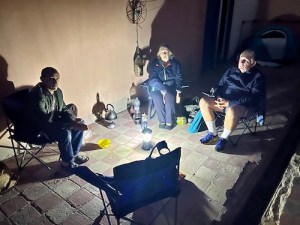
Tonight we did a rather simple dinner, as our late lunch was already so lavish. Fir a while we sat in the car wash bay around the camping lamp, as it was a camp fire, chatting until it got too chilly.
 Abidjan-Marrakech-Abidjan Overland Expedition 2023
You must be logged in to post a comment.