
After we had been woken up by the next door muezzin early morning, some of us had trouble falling back asleep. For Charlotte and me, the night was very restless. Both of us had trouble with our stomachs after last night’s Chinese food. Alex and Trevor were fine. Alex remarked, “the day kicked off with a double blow, as Ulrich and Charlotte succumbed to what I’ve aptly dubbed the ‘Dakar Dumps’.”
Alex had bought some pastries from his favourite bakery around the corner for breakfast. Charlotte and I couldn’t eat anything. I just had two Orange juices to calm down my stomach a bit.
Before it was time to walk to docks to catch the ferry to Île de Gorée, Charlotte and I retreated for a couple of minutes to lay down and gather some strength. She decided to not go, so the three of us left the hotel. A bit further down the road, I had to realise, that it wasn’t a good idea to join them after all and excused myself to return back to the hotel and my bed. Most likely the right decision, seeing that I fell asleep immediately curing my stomach.

Alex wrote, “Their unfortunate encounter with the less-than-ideal digestive situation left them feeling less than stellar. Adding to the twist of fate, Trevor and I, embarking on our own Dakar escapade, unwittingly chose the very day the Senegalese president decided to treat guests to a touristic spectacle. Result? We found ourselves shadowed by police at every turn, patiently awaiting the presidential entourage to conclude their explorations.
While it was disheartening to witness our overlanding leader bow out due to health woes, concerns lingered about potential communication gaps. Nevertheless, we soldiered on, and oddly enough, I found myself welcoming the challenge. Dakar, in all its complexity, proved to be nothing short of amazing. Attempting to encapsulate the experience is tricky, but I’ll give it a shot. Dakar’s essence evoked memories of my time in Asia, seamlessly interwoven with the pleasant recollections from East Africa. Unlike the West African severity felt in Côte d’Ivoire and Liberia, Dakar exuded a blend of people effortlessly going about their day with a careful, helpful, and genuine demeanor. Every Senegalese encounter, from the morning patisserie lady to the 5 pm taxi driver, painted an authentic, honest, and almost romantic portrait of their country effortlessly.”
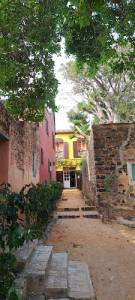
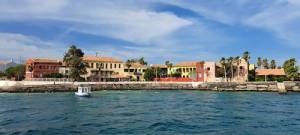
Alex and Trevor continued and went to see Île de Gorée. It is an 18.2-hectare island located 2 kilometres at sea from the main harbour of Dakar, famous as a destination for people interested in the Atlantic slave trade. It is a UNESCO World Heritage and was one of the first 12 locations in the world to be designated as such in 1978. The name is a corruption of its original Dutch name Goeree, named after the Dutch island of Goeree. Now part of the city of Dakar, it was a minor port and site of European settlement along the coast. Being almost devoid of drinking water, the island was not settled before the arrival of Europeans. The Portuguese were the first to establish a presence on Gorée c. 1450, where they built a small stone chapel and used land as a cemetery.
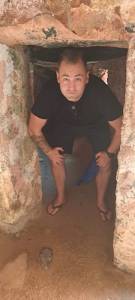
Gorée is known as the location of the House of Slaves, built by an Afro-French Métis family about 1780–1784. The House of Slaves is one of the oldest houses on the island. It is now used as a tourist destination to show the horrors of the slave trade throughout the Atlantic world.
After the decline of the slave trade from Senegal in the 1770s and 1780s, the town became an important port for the shipment of peanuts, peanut oil, gum arabic, ivory, and other products of the “legitimate” trade.
Alex and Trevor were mightily impressed by the state if the island as well as its history.
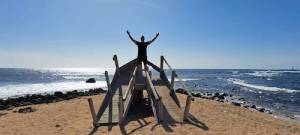
Afterwards we had foreseen to go to the Westernmost point of the African mainland, at Ngor in Dakar. To get to that point, they had to walk through the ruins of the former Club Med hotel. A bit of a challenge, but they managed. That point is nothing very special, but if you have been to the other two more accessible points in the North in Tunisia and in the South in South Africa, and you have the chance to see it, you go and visit it.
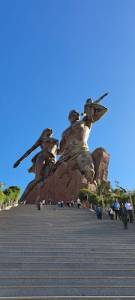
The last point of interest was the African Renaissance Monument, that is a 52 m tall bronze statue located on top of one of the twin hills known as Collines des Mamelles, outside Dakar. Built overlooking the African Ocean in the Ouakam suburb, the statue was designed by the Senegalese architect Pierre Goudiaby, after an idea presented by president Abdoulaye Wade and built by Mansudae Overseas Projects, a company from North Korea.
They walked all the two hundred and something steps up to the platform to have a lovely view from there.
Alex concluded, “today’s high points were the tourist attractions, each leaving an indelible mark in distinct ways. Gorée Island, both incredible and heart-wrenching, served as a poignant reminder of humanity’s journey, often forgotten amidst privilege. The African Renaissance Monument stood out exceptionally, rivaling any monumental impression I’ve had in Rome, instilling a sense of pride in African progress. Lastly, a stroke of luck allowed me to dip my feet in the ocean at the continent’s westernmost point. Amidst the overlooked value of this spot, standing there, overlooking the ruins of the bygone Club Med Hotel and the lighthouse, evoked a humble appreciation for the incredible journey I’ve been privileged to undertake.In the midst of Dakar’s wonders, I also found the time to join Darren’s memorial. The loss of an incredible friend, witnessed through his memorial, resonated deeply. It reinforced the blessing I felt in exploring this remarkable city and discovering the profound offerings it holds.”
I am very much disappointed that I couldn’t join them today, but my stomach just didn’t cooperate. But I am hopeful, that I will return at some point to see these sights myself.
Tonight we stayed in the hotel and had dinner here. Charlotte had already retreated as she was still not feeling well.
Pictures all by Alex. Thanks mate for letting me use them.
 Abidjan-Marrakech-Abidjan Overland Expedition 2023
You must be logged in to post a comment.