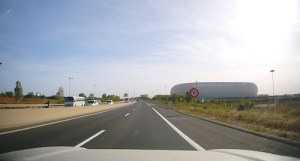
Charlotte and I felt much better this morning. Thank you all for your good wishes. But now it was Trevor, who felt Dakar’s revenge. After a short breakfast with the bakery’s finest coffee buns, Alex had gotten, we settled the bills and went off. Traffic into town was dense and blocking our exit a bit. We filled up and headed out of town on the very comfortable Autoroute 1. We passed a few toll booths and the further we got out of town, the lighter traffic became. About 50km out of the city centre, we passed the new airport. The motorway was very impressive to see and drive on. It is also very well maintained. At two toll booths they had a clever system in place. In order to speed things up at the booth, young men stand in between the queued cars and already exchanged money to the correct amount or even give you change and a specific token you handed in at the booth as a sign that you have already paid. It certainly increased traffic flow through the toll booths. A neat system we could use in Abidjan.
We made good way cruising east through the Senegalese landscape at 100km/h. Quite a few baobab trees left and right. Then, unfortunately, the motorway came to an end. They are working on the extension at the moment, but it will take a while, before the next section is ready.
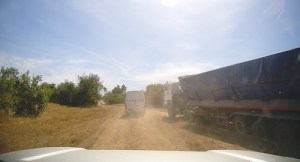
Traffic on the N1 was moderate but with many trucks going east towards Fatick. About 18km before the town, we encountered a major traffic jam of only trucks. Strange, we thought All cars in front of us turned around or drove off the road onto a sandy piste next to the main road. We quickly decided to do the same. So with several cars of all makes and models, we drove down the winding piste, sometimes a few centimetres next to the road and a few times leading us many tens of meters away from the actual road. We started wondering what caused this massive traffic jam of only trucks. Was it an accident, was it road works, was it a demonstration, or was it something else?
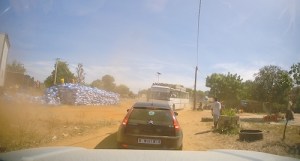
Then we came to a river with a marshland surrounding it. No way we could cross this next to main road. Back on to the main road we went, through a gap between the trucks, we drove onto the opposite lane and passed all the trucks waiting there. A few cars came towards us, but we just managed to pass each other on the narrow embankment. Off the main road again, onto the hard ground next to the embankment, through some back roads of some village. Back across the main road and continuing on the other side. This crisscrossing continued for a while until we finally came to the cause of the monster traffic jam. At the entrance of Fatick, a large truck had fallen over and exactly across the road. Nice blocking the entire National road. Many many helping hands had already unloaded the hundreds of big bags from the truck to the side of the road. While we continued, a police escort brought a big digger from a nearby mine to clear the road swiftly.
The trucks were queuing for more than 15 kilometres in our direction and only those who could pass on the sandy parallel track, the cars, made it passed the crashed truck. A few truck drivers dared to attempt the same as the cars and failed miserably. They got stuck in the soft sand and were waiting for their help. Africa at its best.
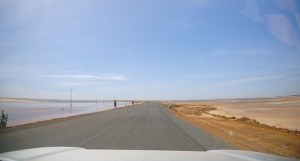
We continued through town to be met by road works stretching all the way to the camp. The entire National Road had undergone a proper remake. Again, we crisscrossed from one side to the other and followed the main road being reconstructed. That, of course, slowed us down.
The road took us through some wide stretched beautiful floodplains, as well as some small villages. The sun was blisteringly hot. We turned off onto a small sandy track to the camp. The track lead us through the fields and grassland of the surrounding villages. When we reached the beautiful camp, situated at the riverbank, we opted for rooms instead of camping due to the heat.
Before we started on our lunch, I organised us a pirogue trip for this afternoon.
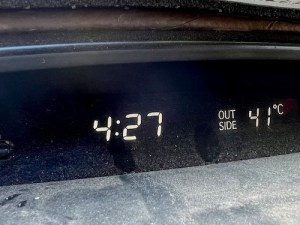
The thermometer still showed 41°C. We had protected ourselves well against all the sun with plenty of sunscreen.
Trevor stayed behind and so, Charlotte, Alex, the guide and me left camp in our cars at four o’clock. Across the fields again, down the sandy tracks, passing under several low hanging branches of mango trees, and through a village, we arrived in another camp. The vehicles were securely parked, while we waited for the boatsman to refill the pirogue’s tank.
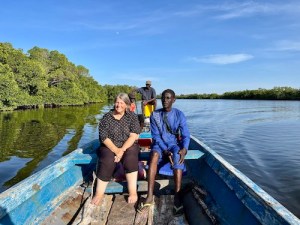
Left and right of this relatively narrow part of the river were mangroves. Then this river arm opened up into the delta with large portions of water and island. The boatsman kept us close to the mangrove trees, as it was cooler there and had more shadow.
All of a sudden, we spotted a monkey sitting high up in one of the trees. The boatsman did a donut to come back for us to take better pictures, but unfortunately by that time the monkey had already descended and was less visible.
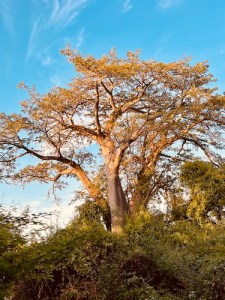
We continued to our destination, the Island of Shells (Île de coquillage). It was formed many thousands of years ago, when fishermen discarded their caught shellfish shells behind them on a sandbank while living there. Over time a big island grew and nowadays, the entire island is covered with vegetation, including some very old baobab trees, that must also be from ancient times. When we arrived, we were not prepared for what we saw. Several boats with in total about a hundred mainly French and Belgian tourists, all seeing sea shells and baobab trees for their first time! Ohh lala, what an excitement!! The most ordinary tourists from probably quite expensive lodges. Our guide explained to us, the significance and importance of baobab trees in their culture and society. They often burry their ancestors at the roots of the tree, as they believe it will let them live on in these old giants.
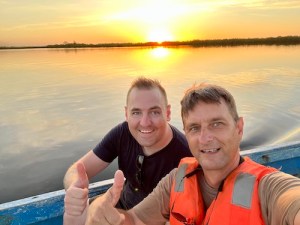
Before we left the island, Alex had a quick refreshing dive off the island, after he had reassured himself, that there were no crocodiles there.
As the sun was setting rapidly, we moved on to the other tourist attraction in these waters. The bird island. In actual fact, it is a number of mangrove trees forming an island, that has been chosen by a few hundred birds as their resting place for the night. There they cannot be bothered by monkeys.
When we got there, a few birds had already arrived. We anchored between the other boats and constantly witnessed new flocks of birds arriving, trying to find a place, fighting with other birds over the best spot and chatting with each other. It was a pandemonium accompanied with the strong bird smells.
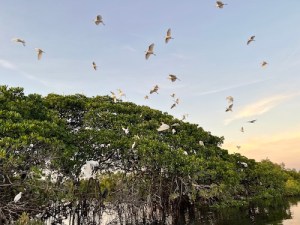
We mainly saw the Little Egret, a few Black Herons and common kingfishers, two massive pelicans, and a few other, I could not identify. We shot plenty of pictures and a few videos before every boat did a last round around the little tree island that was now well filled. The sun had set and daylight was fading fast. Time for us to get back to camp, where our cars where parked. The temperature had dropped to a cool breeze and we were cruising back into the night. Only the almost full moon was illuminating the waters and mangroves. At a certain point, we heard a fish eagle calling. African nature at its best.
Trevor had already voiced his concerns, that we had gotten lost or drowned via WhatsApp. Even there, in almost complete wilderness, you have 4G in Senegal! We told him not to worry, we were only swimming back. It could, therefore, take a while. He was, meanwhile, eaten alive by the mosquitoes back in camp.
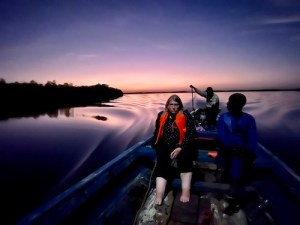
How the boatsman found back to the camp is almost magic in this darkness, but we made it.
After mooring, we disembarked and thanked everyone for an incredible experience. The guide took us back to our camp. Again through the fields and grassland, over sandy pistes we drove, but this time in complete darkness. Thanks to the LED spots on my roof, the surroundings were illuminated nicely and the guide, sitting in my car, directing us, was impressed.
At the camp, we asked what they could prepare for us for dinner and it was chicken with roasted potato wedges. We agreed, and had a drink while waiting for supper to be prepared. We did not expect a three course meal, with an omelette as a starter, the ordered main course, although one portion had to be fish as they didn’t have enough chicken for four, and a fruit salad as a desert. We were chuffed and retreated happily afterwards to our rooms, first to fight the mosquitoes there.
As a side note, this blog entry had to be rewritten for a substantial part, as due to a stupid mistake the first version got missing.
 Abidjan-Marrakech-Abidjan Overland Expedition 2023
You must be logged in to post a comment.