Like the three bikers, we had an early start this morning. When I met Alex in the hotel corridor shortly before seven a.m., he was besides himself and grumpy as hell. He had slept badly, he told me. The bed was as soft as mine but he had a mattress spring poking him in the spine every time he turned, he said. After lots of pampering, we made our breakfast while watching the three musketeers packing their bikes to hit the road to Faranah. A city only about 350km away but with horrendous roads, we will face day after tomorrow. Cars struggle to do this within a day.
We waved and saw them roaring away into the morning. We followed shortly there after. The streets of Dalaba were filled with hundreds of school children rushing to get to school in time. Some were neatly dressed in a beige uniform and others just in normal clothes. Most of them were walking by the side of the road, while others were brought either by their daddies on the back of a motorcycle or the older ones rode a motorbike themselves.
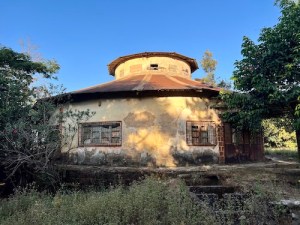
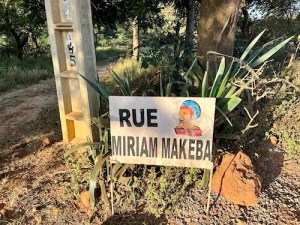
Halfway in the city, Alex remembered that we actually wanted to visit the house of Miriam Makeba, a South African civil rights advocate, actress, singer, and songwriter, who was once married to a Guinean and lived in Dalaba from the late 1960s to mid 1980s and last visited Dalaba in 1988, when she came to see her niece, N’Tombi Makeba, who lived in Miriam’s house (a round building dating to the French colonial period, but using the same form as traditional homes in the region) for a number of years in the 1980s. She also became a diplomat for Ghana, and was appointed Guinea’s official delegate to the UN in 1975. That year, she addressed the UN General Assembly, where she advocated for South Africa’s liberation from apartheid.
We turned around and drove to the house, that I had researched to be her former home. Indeed, there it was, an old traditional round house. The garden was complete wilderness and the house in a terribly sorry state. The intended museum had still not been realised and the house had also not been renovated. What a shame! We snapped a few souvenir pictures and finally left Dalaba for Conakry.
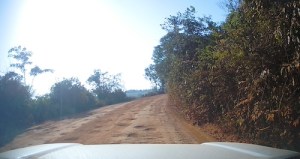
The road winds along the hills and mountains. The road surface often has more holes than a Swiss cheese or is no longer present. Our average speed never climbed above 26km/h for a long time. The entire etappe to just before Mamou took us twice as long as calculated by our navigation devices. From the bypass of Mamou to the hotel, at the outskirts of Conakry in Coya, it took us the same amount of time, but for twice the distance because there were hardly any problems with the road surface. What also really slows you down are all the trucks and communal taxis. The traffic as such is light. Not many people own a car, if they have a little bit of money and own a vehicle, then it is often a motorbike. There is a certain lawlessness on the road in Guinea, although there is quite a bit of police on the road, but much more gendarmerie. Both seem to be rather reluctant to manage the traffic and discipline the drivers.

The gendarmerie has a number of roadblocks throughout the country to check who is moving on the road from A to B as well as sometimes check some documents such as car insurance. We have witnessed that they often receive little gifts from local minibus, taxi and truck drivers. With foreigners they often love to have a chat with you. Where you come from, what you have seen, how many wives you have so far married in Guinea, etc. The road police on the other hand does not seem to be too effective in maintaining law and order on the road. Not only in the capital, but also elsewhere, there is anarchy on the road. Drivers do what they want to do, but that is often not legal, excessive speed, overtaking everywhere, stopping, parking or turning wherever it pleases them. Where Morocco’s traffic was nicely organised and behaving (most of the time), here, it is the total opposite. The landscape on one side, beautifully when the green bushes and trees, permitted.
We encountered several gendarmerie checkpoints but none troublesome. The last one tonight, one of the officers had already looked into the bottle a bit too deep and had trouble standing. The worrying factor was that he was carrying a machine gun over his shoulder. Hopefully only for intimidation and not loaded in his state. His colleague, who spoke to me, was friendly and clearly sober.
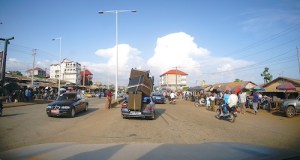
After our quick checkin at the hotel we left for Conakry airport. It was shortly after midday. The sun was out in full swing, only a few white clouds in the distance, but they were growing quickly. It was very sticky. Humidity percentage in the high 90s and temperature in the low thirties. Best weather for being drenched in sweat. Light traffic in town was making the 35km drive to the international airport a breeze. As one of the stoplights turned red, difficult to see due to dirt on the lamps, lots of LEDs of the light packed up and due to all the hustle and bustle around it, a minibus driver tried to still squeeze through red. Three female police officers started shouting at him wildly while approaching him. He had no chance of escaping. A male colleague swiftly placed his motorbike in front of the minibus. Now he was trapped and a massive discussion started in the middle of this crossing, adding more to the chaos in the city.

We arrived after an hour and parked Eeyore on an almost empty parking lot. There was only one flight leaving at this time of the day and none arriving. We held our hearts, that we were let in and that the immigration police was there and not at lunch or otherwise incapacitated. To our amazement, we walked straight past all checkpoints again and to the offices of the immigration police at arrivals. Again, no security checks or questions asked, except how we were doing and coping with the heat. The lady of the immigration police received us and immediately printed us our stickers for our passports. Efficient and easy. Within five minutes we were done. No waiting in line for hours and hassle free. In his best English/French, Alex commended the lady’s beautiful fingernails, that put a big smile on her face and we all chuckled. Within twelve minutes of arriving at the airport, we were done with our mission. This time much easier than anticipated, than the last time in October, when we had to wait behind fifty or so Chinese.

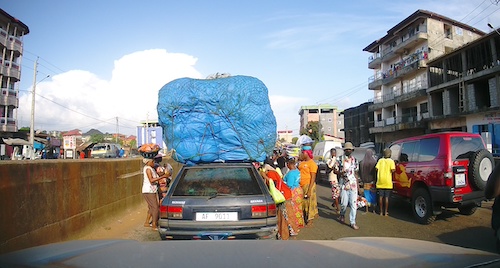
We were hungry. Since breakfast we hadn’t eaten anything substantial. A few little snacks in the car aside. We left Eeyore in the midday sun baking on the parking and rushed across the busy roundabout to a very good restaurant. We ordered the biggest burger they had with some salad and fries on the side. It was delicious and with a full tummy, we left the airport hopefully beating the evening rush hour. We managed to wiggle our way through traffic, that was sometimes coming from all sides, people who had just done their shopping at the local market and now on the phone crossing the street, believing they are alone on this planet, the constantly rushed taxi drivers trying to push in and through, vividly honking motorcycles that tried to tell everyone, “I am coming through and need space” that sometimes wasn’t there, utterly overloaded communal taxis trying to fit yet another passenger in and anyone who thought driving around was just a waste of time and came up the wrong way now blocking others.
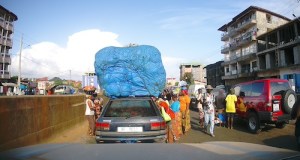
In between were plenty of female hawkers selling anything from overripe bananas, snacks, water, soft drinks, shaving kits, clothes, flipflops, nuts, warning triangles, fire extinguishers, belts, charging cables and much more. Female hawkers walked up and down the waiting cars trying to sell something. Some of them as young as primary school children with heavy plastic dishes on their heads carrying cool water sacks. If you don’t react to their offerings, they knock on the window. I usually just knock back what takes them by surprise and they continue. Alex looks at them with a very angry face to the same effect. Once in a while you have a young boy or girl with a blind grandpa stand at your window demanding money. Sometimes it is also an old imam who then starts reciting, what I believe is, the Quran and then asks for a few notes.
Alex compared the hustle and bustle to that of Antananarivo. I can see some truth in that.
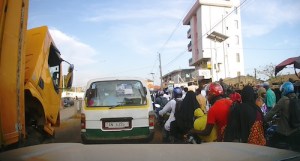
Soon, we came to our last challenge, getting across a busy intersection. One lane was closed due to road construction and in fact due to the enormous traffic jam, especially minibuses also started using the opposite lanes to get ahead. That meant, that in fact five lanes had to merge into one, with a broken down lorry in between and traffic from the side streets too. What a mess it was!! Vehicles literally were coming from anywhere into this crossing and tried to find their way. I saw at least two police officers attempting to do something about this chaos but were totally ignored.
A stretch of 300 meters took us a good hour. It was millimetre by millimetre. Police officers tried to stop motorcycles and were basically being driven over by them. Although this is Africa, but we are sure, this city can quickly wear you out. Alex didn’t want to live here.
We made it back to the hotel eventually and were overjoyed to hold a cold beer in our hands. Mission accomplished in good time and back on schedule after Alex delay arriving in Nouakchott.
On the parking of the hotel, we met a German couple, Heike and Stefan, who we had briefly seen at the border and again along the road much further north a few days ago. We started chatting. Alex shortly introduced himself but left, as his nonexistent German still isn’t good enough to follow our conversation and he was in for a refreshing shower. Heike and Stefan have been on the road since August from Germany and don’t have a final destination or turn around point yet. As they have enough time, they like to explore West Africa in their Toyota Hilux with roof top tent at a slower pace. However, as their next destination was foreseen Sierra Leone, but with the breakout of almost 2,000 soldiers this morning that visit has now been postponed a bit.
 Abidjan-Marrakech-Abidjan Overland Expedition 2023
You must be logged in to post a comment.