

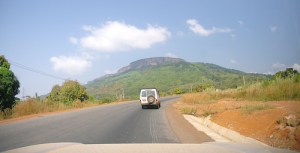
As we only had a bit more than 200km to go today, we were able to take it slower this morning. With the sunlight just making it above the surrounding mountains and a small breeze, we enjoyed our breakfast on the rocks sticking out of the river passing by behind the hotel. A lovely place.
The road heading out of Conakry is used by heavily loaded trucks coming from refineries or the port in the capital, transporting fuel, bitumen, containers, or other goods into the countryside and other cities. Conakry is the country’s only deep-sea port, and therefore, all cargo comes in via Conakry.
Again, we had to stop at about seven or eight gendarmerie checkpoints. All were very friendly and up for a chat. Some recognised us from yesterday’s drive into the city and greeted us like old friends. At one checkpoint, a female gendarme approached our car and requested our car papers. As I always do, I gave her the plastic-wrapped copies of the car papers. She took them without looking at them to a nearby hut and, after asking me to park Eeyore next to the road and come to the hut too, an officer studied the plastic-wrapped papers carefully. With a smile, he asked one sentence, “Where are the originals?” My response was, “Safely, in the vehicle!” He laughed and said, “Never trust a gendarme! You may go. Bonne route!” I wished him a nice day. He was the first one who had noticed the copies, but he could have inspected the originals if he had wished.
We continued and at some point came to a stop with a lot of commotion. We remembered this from yesterday. The same thing. The ministry of transport, together with the police, is checking local cars if they have paid their vignette, their road tax. Every vehicle gets stopped, and someone looking very official types the vehicle’s registration into an app for verification. Basically, all taxis and minibuses bypass the queue and jump to the front. They hold their hand out with some money in it, which one of the guys working there grabs, and they are good to go. Let me guess, they don’t have a vignette, and it is a welcome way to make some money on the side for the police and officers of the ministry of transport. We were waved through as foreigners cannot be checked. But it is not always friendly there, as today, and we witnessed yesterday when some people got angry at the hold-up or because they got caught.
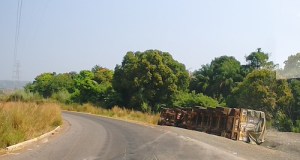
Along the national road are the remains of many accidents still visible. Some are trucks that are badly smashed or have fallen off the street into the ravine, some are also cars that burned up beyond recognition, usually after accidents.
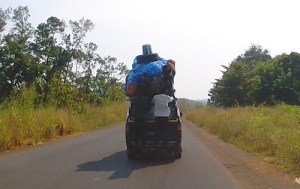
It is no wonder that so many accidents happen on this route. The road is new and smooth, inviting to drive fast. There are a million bends in this mountainous area road making it hard to see oncoming traffic and having a slow-driving truck ahead of you. The many motorcycles do add to the accident potential as they often overtake with centimetres to spare. A lot of taxis and minibuses are completely overloaded, not only on the inside with passengers but and especially on top with all the goods they are transporting, making their internal point of gravity very high. In sharp bends, they often lean dangerously outward, and we are only waiting to witness one tipping over.
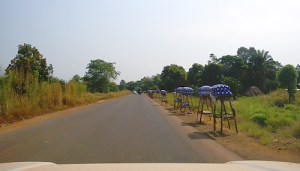
We crossed the town of Kindia, which is known for its fabric dyeing. Along a stretch of the national road, you will find a large number of stalls on high feet, displaying pillows in various colours but mainly blue, the typical colour of the region.
Before reaching Mamou, we gave our thirsty Eeyore some more to drink. Then we went on the search for some baguette, which we eventually found in a wheelbarrow next to the road but no owner. We asked the nearby shop owners, but no one seemed to know where she was. Almost, we grabbed two baguettes and left some money behind when one of the shop attendants signalled that she was just crossing the street. The baguettes here are very delicious. Very crunchy and rich on the inside, made with proper flour. In Côte d’Ivoire, the baguettes you can buy at every street corner contain a certain percentage of rice flour, which makes them very light and fluffy but not rich. They also dry out very quickly.
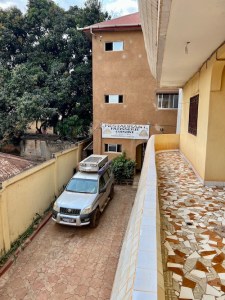
Alex and I reached the hotel that I had chosen. It looked ok, for what we were expecting. We checked in. Here we learned the reason for our internet problems we encountered since yesterday. According to the state TV, there has been a sabotage aimed at the country’s internet that slows down all digital traffic. Mostly affected are WhatsApp and Facebook, what a lot of people here rely on for communication. We will have to cope with it as long as it lasts. The messages are fortunately coming through but very slooooowly.
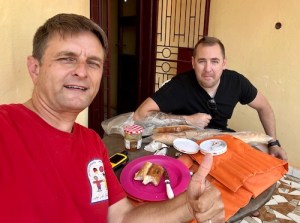
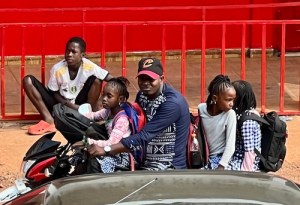
On the first-floor public balcony, we found two chairs and a table. The perfect spot to have our lunch, baguette and cheese. Unfortunately, the marmalade had not survived the heat of the last days. We watched the primary school next door finishing for the day, and all children in uniform, khaki for the boys and blue-white chequered for the girls. At exactly two o’clock the gates opened, and the kids ran out and home. Some were picked up by fathers on motorcycles or one by car. The last one to leave was the teacher who also locked the gate. The afternoon we spent doing administration, reading, cleaning or sorting things for the last couple of days on the road.
 Abidjan-Marrakech-Abidjan Overland Expedition 2023
You must be logged in to post a comment.