We slept well until we were woken up by the muezzin of the mosque right next door around 5:45. After a quick cold bucket shower, we were out at Eeyore for our muesli. Because the Moroccan milk was finished, we had to resort to our back up, the milk powder, that we mixed with mineral water. Easy and you hardly taste the difference in muesli.
A last picture with the owner and we set off at exactly eight a.m., the time we had given ourselves. Eeyore had a full tank, so we could leave town straight away. Again, we came across a couple friendly police and gendarmerie checkpoints, but most of them were just checking our papers or let us pass through straight away. The road at first was in reasonable condition and we were making easy kilometres. Cruising through the Guinean hills on our way south to the town of Guékédou, which lies just a stone throw away from Liberia.

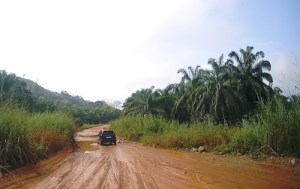
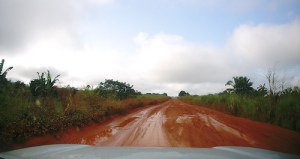
Then, we were surprised by a non-existent road surface and a million potholes, some as large as swimming pools and all were still filled with water from last night’s thunderstorm. Their depth was anyone’s guess. It was very difficult to manoeuvre and find the best and least bumpy route through this maze of potholes. Eeyore took one punch after the next unfortunately. Progress was slow and our pace was around 10km/h.
The hope was that in town, we would find better quality streets. We did indeed, but they were all side streets but not the National Road we were on. It actually got worse due to rocks and inclines. At a certain point I had enough of all this bumping around and took a side street and rather drove a bit around on tarred roads. The plan worked only to be confronted with a bridge crossing that was again rough and bumpy. After a roundabout, the road became again good quality and recently seemed to have been enhanced and resurfaced. Traffic is, as always on the country roads of Guinea, light, a few trucks and taxis but no remarkable traffic. We followed the Liberian border in a few kilometres distance eastwards. Often we drove through, what I call, the green tunnel: trees on either side of the road and for the rest lots of bush and grass that form a sort of green tunnel. The green is often encroaching onto the road, leaving just enough space for a truck and a car to squeeze through. Sadly, you don’t really see anything of the landscape as the sides are one green impenetrable wall.
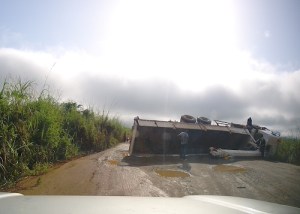
Then, the first major problem with Eeyore happened. We noticed, that, all of a sudden, the temperature inside the cabin increased and the air coming out of the air vents wasn’t as cold as we were used to. We stopped along the road and investigated. The air conditioning seemed to be out of gas and the reason for this must be a small leak somewhere. Bur where? That can only be tested and found at home in Abidjan. So for the remaining kilometres, we are in for the full African heat experience driving with open windows.
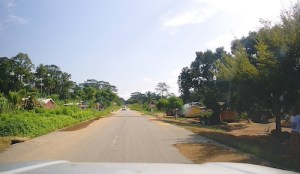
Whenever you come through a small village in Guinea these days, you will see large quantities of seeds spread out next or even on the road. Women are drying their harvest mainly rice, various beans, and black pepper. Some carpets of seeds are strategically placed on the road that you have to drive across. It seems to be wanted to separate or squash seeds. Now with the windows open there are certain smells coming into the cabin of the various seeds and pepper.
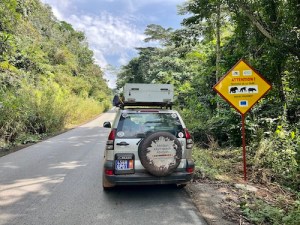
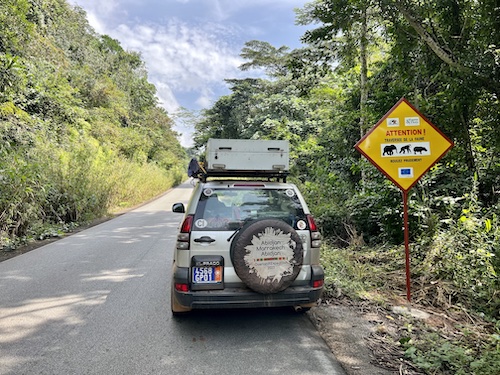
After Macenta, the landscape changed and more prime forest became visible on bigger hills and smaller mountains. We came across a very special sign, we hadn’t seen before, warning us about crossing wildlife: elephants, chimpanzees and hippos. Apparently the signs are part of a campaign and were partially sponsored by the European Union. Of course, we had to stop and take a picture of Eeyore next to it.
The road stayed in reasonable good condition, so that we could eat up more kilometres and advance towards the border with Côte d’Ivoire in good time.
We arrived in the last major city before the border, Nzérékoré.
The policeman checking our car papers leaving town was the first one to notice immediately, that I had given him copies and asked for the originals. As everything happened in a relaxed sphere and I didn’t expect any trouble, I gave him the originals. He studied them carefully, before asking for my driver’s license. He looked at my picture and then at me and back at the license to study my date of birth. He said, that I look better on my license picture. I replied it was by now about 8 years old. He found, with a big grin across his face, that I looked older in reality. I laughed and before giving back the documents, he said that Alex looked like being from 1995. I translated that for Alex and he thanked him for the nice compliment as he is a bit older than that.
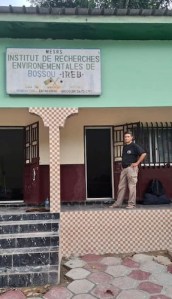
We continued heading towards the border with Côte d’Ivoire. Before we cross, we did not want to miss visiting the “Institut des Recherches Environmentales de Bossou (IREB)”. I had read about them a couple of times in my research for this trip and on the various overlanding fora. I then heard about them during my climb of Mount Nimba last year in May. Through them you can not only climb Mount Nimba from the Guinean side, but also visit the chimpanzees living around Bossou and Mount Nimba. In March 2019, I had the privilege to visit the Comoe National Park and the German research centre located there. It was also there that I met Juan Manuel Lapuente, who heads the Comoe Chimpanzee Conservation Project there, and learned so much from him about the chimpanzees in West Africa and in Comoe NP, in particular.
I now wished to learn more about the chimpanzees in the region. And if you have a chance to see them on your way home after such an incredible expedition, that is an absolute bonus and extraordinary opportunity that you cannot miss.
We took off the main route to the border some 40 kilometres before the border crossing and hobbled down a bit washed out track to the village of Bossou, some 15 kilometres off the main route. We arrived by crossing the adjacent football field, that later became a battle field between two local teams with lots of spectators and emotions.
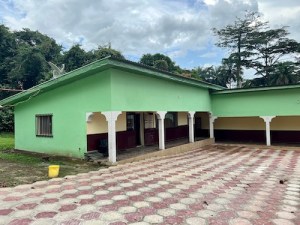
The institute is being refurbished at the moment. The square, around which the buildings are situated, was being re-tiled and pointed when we arrived. One of the assistants and the head of the institute welcomed us. He showed us around and explained a few things. As the renovation was still ongoing and the workers sleep in the rooms they usually rent out to guests, they quickly prepared and cleaned two rooms for us. They are simple but now certainly clean. There is no bed in my room and the mattress is on the floor, but that will do for a night, especially if you are only paying 70,000GNF (~7€) per room per night.
After we had moved in, I started chatting with one of the researchers there. With pride he showed me their remote cameras, they hang up in the forest to capture the wildlife. This camera has also taught them, that there is plenty of more wildlife in the area than they had know, such as a pair of plack panthers, they didn’t expect at all to see on one of the video footages. They are chuffed to have such extraordinary wildlife in their forests. On the hill next to the village Bossou live four chimpanzees, two male and two female. Around Mount Nimba the estimate runs between 250 and 300 chimpanzees, he told me.

Tomorrow, if all is well, we shall visit the Bossou chimpanzees in the morning with a ranger.
For today, we asked about dinner and beer. They could not easily provide any food for us, but one of the assistants got us some beer to quench the first thirst of driving and then for with dinner.
Stoked about this good news about tomorrow, we dove into our provisions and chose Chili con Carne with rice for supper. The camping set was quickly set up and the pan with rice and water stood on the stove boiling away. The Chili got heated afterwards and we had a yummy dinner with Guinea’s finest beer on the porch of the dormitories. Happy days!
 Abidjan-Marrakech-Abidjan Overland Expedition 2023
You must be logged in to post a comment.