The car was wet, covered in dew this morning and it was quite cloudy. It was scarcely light when we hit the road, first searching for an ATM which took us to 3 banks before we could get cash.
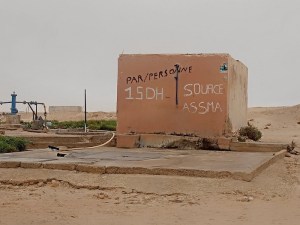
We had read about a hot water spring just off the road a few kms before the roundabout at the N1. It was easy to find, about 200 metres off the road, a pink building with a pipe leading from a pump in the ground. As it was early morning, not even the person who collects money to use it was around. The tap was turned off but it was dripping at a few places along the pipe and tap and we could feel it was hot with a strong sulphury smell. We didn’t spend much time there before heading to the fuel station to fill up. Fuel is quite a bit cheaper in this region than the rest of Morocco (12 Dhs vs 14 Dhs).
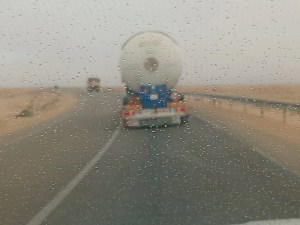
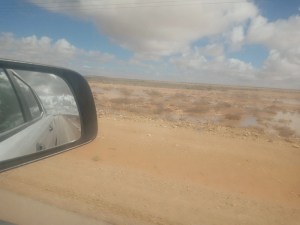
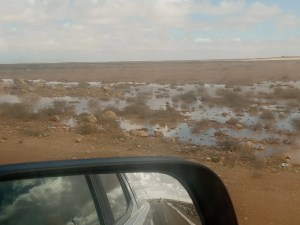
As we left the filling station we saw a few spots on the windscreen, rain in the desert! It was just a few spots now and then and eventually enough for the automatic windscreen wipers to activate, but barely enough to make a mark on the ground. As we drove further north it and as we approached Boujdour, it became evident that quite a bit of rain had fallen in a widespread area as there were large pools of standing water.
Compared to the adventures of Ulrich and Alex in Guinea, we seem to be on a boring part of the trip: long, straight, good tarred roads, with little traffic enabling us to cruise along with ease at the 100km speed limit. The road is quite close to the coastline so we stopped every so often to take a picture of the cliffs and coastline. At one point as we came back onto the maim road from being at the cliff, we decided to change drivers and made a quick stop for the handover.
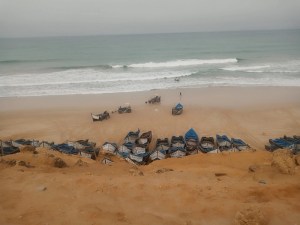
The driver of a car that had stopped on the other side of the road heading in the other direction, came across to ask if we had any problems or needed help as he said he saw us stop at the cliff and now stopped again and we had gotten out of the car. Trevor told him that we had just stopped to see the sea view (although it was misty) and we were now changing drivers. He said that was fine but we wondered whether he may have been a plain clothes policeman checking on his colleagues patrolling the coastline. The Moroccan coastline is dotted with police and military points (a small building usually with a solar panel and big water tank), about 1km apart. They monitor the coastline for incoming or outgoing traffic. Apparently the EU has put a lot of pressure to reduce illegal migrants from embarking on their journeys from the Moroccan coast and supposedly these lookout posts are part of that and are perhaps even funded by the EU.
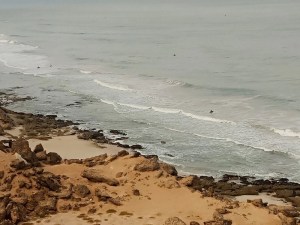
At one of our stops we saw a number of people each in what looked like a truck or tractor tube floating in the breakers, with one or two quite far into the ocean. It was not clear whether they were just having fun in the waves or whether it was a more sinister motive.
At the entrance to the town of Boujdour (we slept there on the way down) we stopped at the police checkpoint and were asked for passports and where we were headed. They took the passports and a photo of the car number plate and went into their roadside hut, emerging a short while later and giving us back our passports and wishing us a good onward journey.
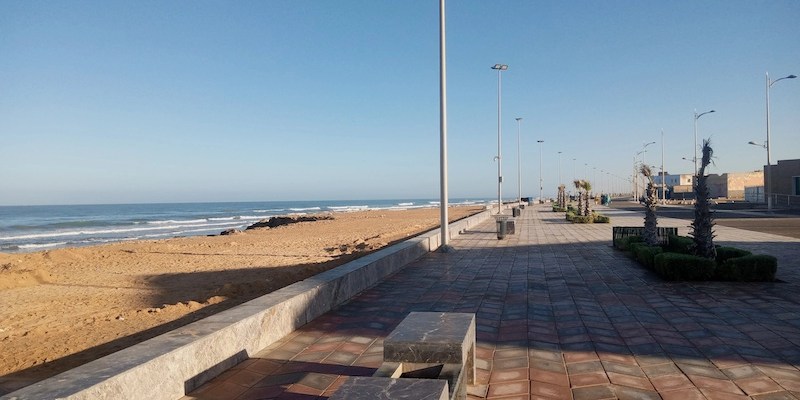
We arrived at the apart hotel, Rio del Mar in Foum el-Oued, on the seafront, to find the seafront area has been developed into a pedestrian zone so cars have to use the back roads. We found he place quite easily and were given a big ground floor apartment so we can park the car right outside the window.
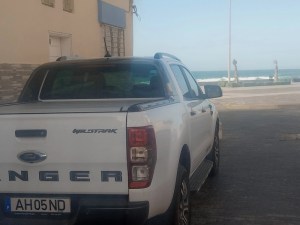
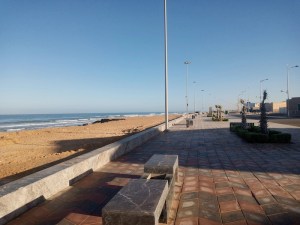
We took a walk along the seafront but it was quite windy and chilly. The sea is quite rocky just in front of the hotel but with some small sandy beaches a few hundred metres right and left and 2 much bigger sandy beaches at each and of the little town.
For dinner we had the leftover mutton mechoui.
 Abidjan-Marrakech-Abidjan Overland Expedition 2023
You must be logged in to post a comment.