
The night was mild, but humid. We were right at the coast never the less. When we woke up this morning, our cars and tents had quite a bit of dew on it, that one could have thought that it had rained overnight. It hadn’t. 16°C and 100% humidity and some fog, let’s you collect dew on colder items.
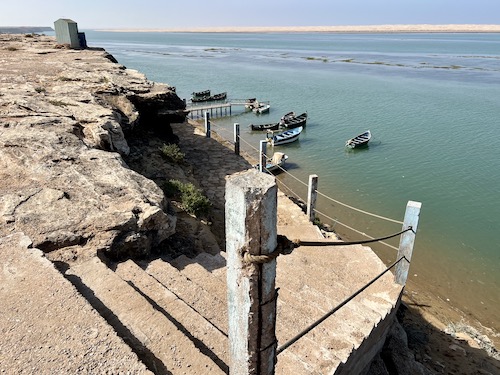
Our morning routine had us shower, have breakfast and pack in efficiently. Ready to hit the road. Not quite yet. Trevor wanted to see the little beach and harbour of Mirleft. So we drove down the street and already saw, that the other side of the canyon was hardly visible due to heavy fog. We made it to the beach parking, had a look and snapped a few pictures.
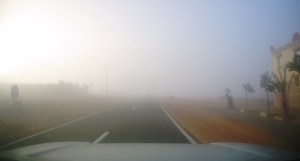
Further along the coast the fog was so dense, that you could hardly see the car in front of you. Less than a hundred meters certainly. It was a hilly road, hugging the coastline. We came to the spot where the famous natural arch of Lagzira can be visited. The access road had been closed by the authorities years ago, because tourists were making a mess out of it, stayed overnight, had parties and left their garbage behind. Today, we would have walked the ca 1500m from the road to the beach but, unfortunately, the visibility was so bad, that you probably wouldn’t have seen anything. I had so looked forward to seeing this stunning piece of nature myself, but nature prevented it. So with a heavy heart we carried on.
The small road took us to Sidi Ifni, which look quite sleepy so early on a Saturday morning. The RN12 lead us away from the coast through various hills back to Guelmin. By this time, we needed some fuel. The first petrol station, that looked decent was ours. With full tanks, we headed out of town to be stopped by the gendarmerie at the city exit. The officer seemed to be more curious, than anything else. What kind of a funny number plate was my vehicle carrying? He inspected the car papers thoroughly before handing them back with a scratch at his head.
As soon as I saw the first sign saying Laayoune, it reminded me visually that from now on, I am really on my way home.

The new expressway from Agadir all the way to Dakhla is taking good shape and the works are progressing. Even in those three weeks since I last driven on this road, I can see progress. Often you are allowed to already use the parts that are ready and sometimes you need to use one side of the new route while they are working on the other side. Occasionally, you also have to use the very old part, that is hardly wide enough for two vehicles to pass. Once the entire expressway is completed, it will be smooth sailing into the South, it might become a bit monotonous and boring though.
We spotted a few travellers on our way today, two people on a bicycle, taking advantage of the still closed side of the expressway going south, a few RVS and a Swiss overlander who did the perception of his nationality full honour. He drove verrrry sloooowly.
The expressway took us back to the coast and we stopped at a lovely spot with a view over the cliffs and the coastline.
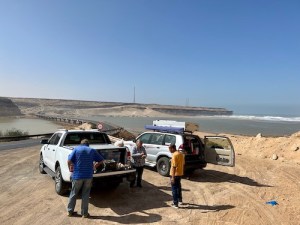
Descending a road through the rocks into a oued, I spotted a nice Part of the hard shoulder, where we could have our lunch break. With a lovely view over the old and new bridge and the entire oued, that actually carried quite a substantial amount of water, we ate our lunch and watched the vehicles drive past.
The last kilometres of today were as boring as the others. Lots of emptiness on both sides, apart from some construction of the expressway. Then came our turn-off.
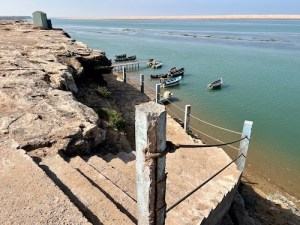
We entered the Khenifiss National Park. It is a Moroccan national park, that was established in 2006. The area of the park is 1,850 square kilometres. It was created to protect desert, wetlands, and coastal dunes.
The National Route 1, we drove on, which runs along the Atlantic coast, passes through the park. The park includes a coastal portion, the Khenfiss lagoon, the biggest lagoon at the Moroccan coast, and the inland portion, located on desert plateaus. The lagoon is also an important bird nesting ground. Every year, about 20,000 birds stay in the lagoon area in the winter season.
The inland part includes sabkhas and is typical for Sahara landscapes. It also includes sand dunes and limestone plateaus. The government declared its intention to turn the park into a major tourist attraction specializing in ecotourism.
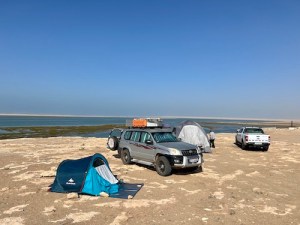
We asked the guard, whether we could camp here one night and he agreed. At the parking, in front of the fishing harbour, we looked for the best spot to set up camp. Once Trevor had found it, I parked Eeyore next to their tent. Late afternoon, a Dutchman Stijn arrived on his bicycle and set up his tent not far from ours. He is on his way from Tangier to South Africa by bicycle. What an endeavour, I can only admire.
Later more French and Swiss campers arrived. We sat at the edge of the cliff with Stijn and chatted a bit while having an apero. A military guard made his round and took pictures of all passports and entry stamps as well as the number plates to register them properly for staying the night here.
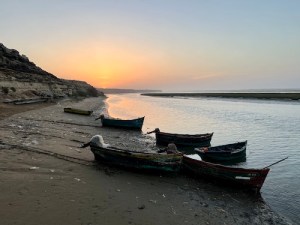
The last bit of sun that was left was all of a sudden taken away by a rapidly closing in fog bank. Fortunately it only lasted a good 15 minutes as I had already feared that I would miss the sun setting over the dunes in the distance. The fog moved inland and the sky cleared again. The sunset later was magnificent.
Our dinner was simple, pasta with tomato sauce I had brought. Even more campers, we counted nine, arrived and tried to squeeze in somewhere for the night.
 Abidjan-Marrakech-Abidjan Overland Expedition 2023
You must be logged in to post a comment.